
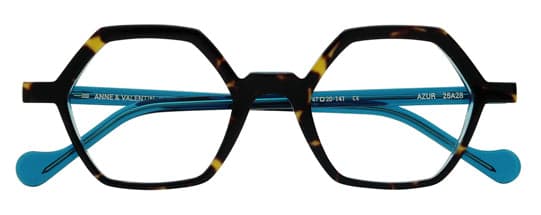
On very pale skin with true cool undertones — porcelain tones, blue-toned lips — warm tortoise frames tend to make the complexion look sallow, while a smoked grey-green acetate blend, the kind Anne et Valentin does well, usually brightens it. The right tortoise for cool-tone skin exists — it just isn't what most wearers picture when they hear the word "tortoise."
Tortoise is the single most versatile frame color in eyewear. It's also the color most commonly mis-chosen, because the default "tortoise" at many chain stores skews warm — and many wearers have cool-tone or neutral undertones that don't flatter warm amber.
Quick Answer — what cool-tone tortoise looks like
Cool-tone tortoise uses ash-grey, cool-brown, smoke, olive-green, or charcoal base colors rather than warm amber and caramel. The flecks are often smaller, less saturated, and pulled toward cooler hues (grey-brown rather than honey). The effect is still recognizable as "tortoise," but it flatters cool skin the way warm tortoise flatters warm skin.
If your default is warm tortoise and you have cool-tone skin, you're leaving visual impact on the table. The right cool-tone tortoise does for your face what the wrong warm tortoise undoes.
The skin-tone test — in 30 seconds
If you've never checked your undertone, the wrist-vein test is the fastest way:
- Sit near a window in natural daylight.
- Turn your wrist so the underside faces up.
- Look at the veins running down your wrist.
- Blue or purple veins = cool-tone undertone
- Green veins = warm-tone undertone
- A mix = neutral undertone
Second confirmation test:
- Hold a sheet of pure white paper next to your face in a mirror.
- Hold a sheet of cream/off-white paper next to your face.
- If the white paper makes you look fresh and the cream looks dingy — you're cool-tone.
- If the cream makes you look fresh and the white makes you look stark — you're warm-tone.
- If neither is obviously better — you're neutral.
Neutral wearers can wear both warm and cool tortoise with decent results. Cool-tone wearers should lean cool. Warm-tone wearers should lean warm.
Why warm tortoise fights cool skin
Color theory gets specific here. Cool-tone skin has blue or pink undertones. When you place warm amber, caramel, or honey-gold tortoise near cool skin, two things happen:
- Undertone clash. The warm color temperature fights the skin's cool undertone. Your skin can look greyer, more sallow, or flatter than it actually is.
- Reduced contrast. Warm tortoise on cool skin blurs visual edges — the frame doesn't create the definition good eyewear should.
The inverse is also true: cool tortoise on warm skin can look dull and lifeless. Warm-tone wearers benefit from warm tortoise for the same color-theory reason cool-tone wearers don't.
The best cool-tone tortoise brands
Specific brands commission acetate formulations that work for cool skin. A shortlist:
Anne et Valentin — grey-green and cool-smoke blends
Anne et Valentin's acetate expertise shows up most clearly in their cool-toned colorways. The brand regularly offers tortoise variants in grey-green, smoke-charcoal, and cool-olive base colors. These are custom Mazzucchelli formulations specific to the brand.
Retail runs roughly $385-$715. The Barceloneta ($445) and Brooklyn ($495) models are typically available in at least one cool-tone tortoise per season. Our Anne et Valentin spotlight covers more.
Jacques Marie Mage — smoked and olive colorways
JMM doesn't do "tortoise" in the Italian sense — they do colorways named for specific cultural references. The Noir 15, Corbeau, Venom, and Obscure colorways across various models pull toward cool olive, cool brown, and smoked green families. Limited production runs per colorway.
Retail runs $985-$1,385 across core models. If you're chasing a specific cool-tone JMM, check boutique inventory early — these colorways move fast. Our Jacques Marie Mage spotlight covers the brand.
Lindberg — charcoal and grey horn
Lindberg's horn line uses buffalo horn, which naturally produces cooler color ranges than acetate. Charcoal horn, grey horn, and smoke horn variants are all cool-tone-friendly. Horn has a different visual quality than acetate — more organic, less uniform — which some wearers prefer regardless of undertone.
Buffalo-horn models start around $2,400 ($2,360-$2,560 at retail). The Horn series is premium within the Lindberg lineup. Our Lindberg spotlight covers the brand.
Oliver Peoples — ash-tortoise colorways
Oliver Peoples's ash-tortoise colorways are specifically cool-tone tortoise. The brand's Hollywood heritage makes it one of the more accessible options — distribution is broader than Anne et Valentin or Nina Mur, and core acetate optical frames retail at about $415-$495.
Oliver Peoples isn't technically a fully independent brand anymore (acquired by EssilorLuxottica), but the craftsmanship remains high and the color options are thoughtfully designed.
Gazal Eyewear — special-order cool colorways
Our house brand produces primarily warm tortoise and bold color acetate, but we commission small runs of cool-tone variants for specific models. The Bella and Libra models have cool-tone variants on request, at the acetate end of Gazal's $400-$1,200 range.
For wearers in the Atlanta metro, a boutique visit to Gazal Eyecare in Roswell can put you in front of the current cool-tone Gazal inventory.
The fit test — at the boutique
When you're actually trying tortoise frames in person, skip the display mirror and try this sequence:
- Put the frame on.
- Hold your face near a window in natural light.
- Look at the transition from frame to cheek.
- If your skin looks brighter and more defined — the tortoise is right.
- If your skin looks sallow, grey, or dull — the tortoise is wrong.
This test cuts through the noise of "do I like how this looks" versus "is this actually flattering my undertone." A good boutique optician will run this test unprompted.
Cool-tone tortoise comparison table
| Brand | Colorway to request | Material | Retail |
|---|---|---|---|
| Anne et Valentin | Grey-green blends, cool smoke | French acetate | $385-$715 |
| Jacques Marie Mage | Corbeau, Noir 15, Venom | Acetate | $985-$1,385 |
| Lindberg | Charcoal horn, grey horn | Buffalo horn | $2,360-$2,560 |
| Oliver Peoples | Ash-tortoise colorways | Acetate | $415-$495 |
| Gazal Eyewear | Cool-tone special orders | Premium Italian acetate | $400-$1,200 |
Where to actually find cool-tone tortoise
Your best path is a boutique optical that stocks multiple independent brands in each season's colorway rotation. Most chain opticals skew warm because warm sells broader, so finding cool tortoise there is a lottery.
Some boutiques worth planning a visit to:
- Gazal Eyecare in Roswell, Georgia — Anne et Valentin, JMM, and Gazal cool-tone options.
- L'Optique in Asheville, North Carolina — broad Anne et Valentin selection with strong cool-tone rotations.
- Blinka Optical in Geneva, Illinois — Chicago-area; deep JMM and Anne et Valentin inventory.
- Bixby Eye Center in Peoria, Illinois — central-Illinois boutique with seasonal cool-tone tortoise options.
Or find more at the practice locator.
The bottom line
Cool-tone skin deserves cool-tone tortoise. The default "amber tortoise" at many chain stores skews warm, which is wrong for many cool-toned wearers, and switching to the right acetate formulation can transform how the frame reads on your face.
Identify your undertone with the wrist-vein test. Shortlist Anne et Valentin, JMM, Lindberg horn, Oliver Peoples ash tortoise, and Gazal cool-tone options. Run the natural-light cheek test when you try frames. Don't accept "tortoise" as a single color — it's a family, and the family has warm and cool branches.
For help navigating the options, find a boutique practice near you that stocks multiple independent brands across color ranges. The right tortoise for cool-tone skin is worth the visit.
Frequently Asked Questions
How do I know if I have cool-tone or warm-tone skin?
The classic test: look at the veins on the underside of your wrist in natural light. Blue or purple veins = cool-tone. Green veins = warm-tone. Mixed = neutral. A second test: hold a piece of pure white paper and a cream-colored paper next to your face. The one that makes you look fresher is your undertone direction.
Can cool-tone skin wear warm tortoise at all?
Sometimes, with restraint. A smaller, subtler warm tortoise frame in a medium size can work for neutral-cool skin. Large warm amber tortoise frames almost always fight cool-tone skin — the yellow and orange undertones pull the face toward sallow. When in doubt, go cool.
What's the difference between 'tortoise' and 'havana'?
Havana is the classical Italian name for what Americans call tortoise — warm amber and caramel acetate with dark flecks. It's typically warmer and more saturated than generic 'tortoise.' Cool-tone skin should generally avoid havana specifically; look for 'smoke tortoise,' 'ash tortoise,' or 'olive tortoise' instead.
Which brands do cool-tone tortoise best?
Anne et Valentin's grey-green blends, Jacques Marie Mage's smoked and olive colorways, Lindberg's charcoal horn options, Oliver Peoples's ash-brown variants, and some Gazal Eyewear special colorways. These brands commission acetate specifically in cool-tone color families, unlike mass-market brands that produce mostly warm tortoise.
How does the Italian Mazzucchelli mill produce cool tortoise?
Mazzucchelli produces hundreds of acetate formulations. Cool tortoise uses grey, green, blue, or black base layers rather than amber. The flecks are usually smaller and less saturated. Brands that care about cool-tone options (Anne et Valentin, JMM) commission specific formulations from Mazzucchelli rather than using standard warm stock.
Are cool tortoises harder to find?
Yes. The mass market skews overwhelmingly warm because warm tortoise is the cultural default. Cool tortoise typically requires boutique independent brands that source custom acetate. Expect to see more warm options than cool at any given boutique; good boutique opticians can order cool-tone frames on request.
Newsletter
Independent eyewear, in your inbox
Monthly stories on the world's finest independent eyewear brands and boutiques.
Related Reading
Best Fall Frame Tints for Warm Skin Tones — The Honey, Cognac, and Amber Playbook
Warm skin tones shine in fall tortoises. A fitting-counter guide to honey, cognac, and amber acetates — plus the mid-tone shade most people overlook.
Finding Your Color Season for Eyewear — A Practical Guide
Personal color analysis (the "seasons" system) applied to eyewear — how to use it without turning frame shopping into a whole personal styling project.
Frame Colors That Flatter Gray and Silver Hair
Gray and silver hair changes how frame color reads against your face — here's what actually complements it instead of competing with it.
Comments
0 comments · moderated
No comments yet. Be the first to weigh in.