
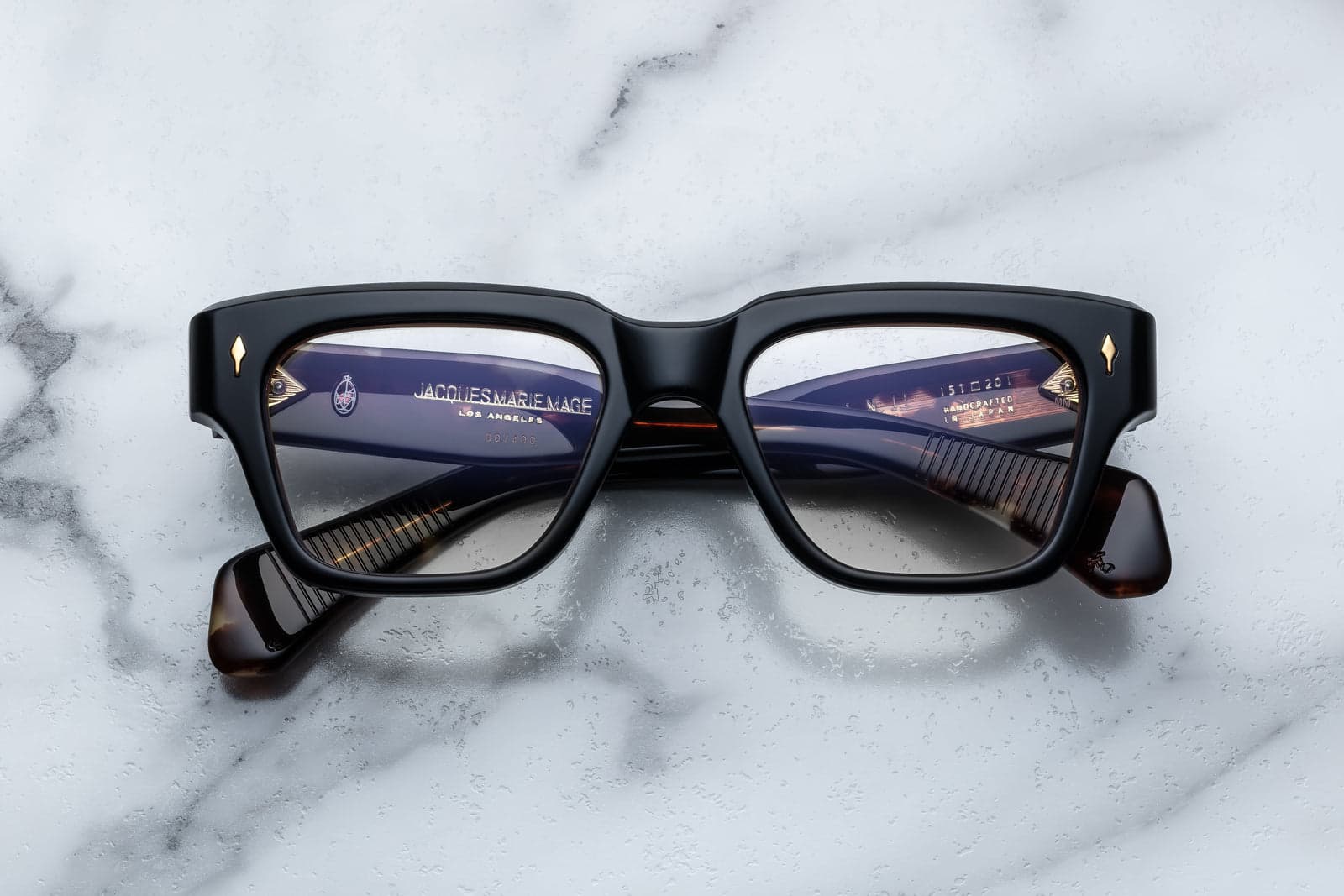
Jacques Marie Mage was founded in Los Angeles by Jerome Mage in 2014-2015, and longevity is kind of the point of this brand.
Eleven years later, Jacques Marie Mage has done something nobody in eyewear has done before: created a collector market that behaves like sneakers, watches, and streetwear. Discontinued colorways resell above retail. Waiting lists on new drops stretch months. Boutique opticians compete to get the best allocations. And the frames themselves — made in Japanese workshops, from thick hand-polished acetate, in runs of a few hundred pieces — are still genuinely beautiful objects.
Quick Answer — what Jacques Marie Mage is
Jacques Marie Mage is a Los Angeles-designed brand founded by Jerome Mage (2014-2015), made in Japan and Italy in limited runs. Every model is named after a cultural icon and retails from $985 for optical frames (core models $985-$1,385, limited editions past $2,000). The brand operates as much like a rare-sneaker drop as a traditional eyewear company — and the collector market responds accordingly.
The origin story
Jerome Mage grew up in Nice, France, moved to Los Angeles, and worked at L.A. Eyeworks and DITA before founding JMM. The DITA period is important — that's where he learned Japanese-production fundamentals and worked directly with the Fukui workshops that still make JMM frames today. The L.A. Eyeworks period is where he absorbed the Hollywood storytelling instinct that shapes every JMM release.
The first collection launched with five models. The Fellini, the Molino, the Taos, and the Dealan were in that first drop — and Dealan, Molino, and a few others are still produced in rotating colorways today. That sustained catalog is unusual. Most fashion eyewear brands cycle entire lineups every 18 months. JMM builds models into signatures.
The naming convention — every model a cultural figure or reference — is the backbone. The Dealan for Dylan. Zephirin is a saint. Yves is Saint Laurent. Torino is named for the Teatro Regio Torino opera house. When you buy a JMM, you're buying into a storytelling ecosystem that pre-existed the eyewear. That's why the resale market cares so much about which colorway you have — Dealan in Noir is different from Dealan in Havana, not just visually but narratively.
The production — Japan and Italy, not just one or the other
Per JMM's own site, the brand is designed in Los Angeles and handcrafted in both Japan and Italy — not a single-country production story. The hand-polishing and artisan finishing work happens in Fukui, Japan, the region responsible for the overwhelming majority of Japan's eyewear production and the concentration of craft skill that comes with it. JMM works with multiple Fukui workshops, each specializing in a different production step.
The acetate itself varies by collection: trade press consistently reports JMM's signature acetate as a custom Mazzucchelli blend developed with the brand specifically for its exclusive colorways, while some lines (including the Titanium Series) use Japanese-sourced Takiron acetate instead. Either way, the material runs noticeably thicker than typical luxury acetate — commonly reported around 6-8mm — which is why JMM frames have that specific heft when you pick one up.
The hinges are where JMM's engineering shows. Proprietary rivet construction, not screws. Once set, they don't loosen. Adjustment requires heat and a trained optician. If you've never tried to adjust a JMM hinge by hand, don't — you'll damage the acetate.
The signature models — which does what
A field guide to the most-asked-about JMM models:
- Enzo — the archetypal mid-size optical. Classic P3 shape. Best first JMM for most wearers. $985.
- Molino — slightly larger aviator-adjacent sunglass. Hollywood-cinematic silhouette. From $985 (Molino MX $1,155).
- Dealan — the one everyone wants. Thick acetate, rounded square, named for Dylan. From $985 (Dealan MX $1,155, Dealan TI sun $1,385).
- Torino — angular square sunglass. More contemporary than the Dealan. $985 (Torino TI sun $1,385).
- Zephirin — refined classic optical, narrower bridge, sized for more elegant faces. From $985 optical, $905 sun.
- Yves — homage to Saint Laurent. Bold statement square. From $985.
- Jagger — rock-and-roll cat eye. Smaller face, sculptural presence. $1,270.
- Fellini — smaller round, restrained, suits professional wear. From $985.
- Molino 55 — smaller-size Molino for narrower faces. $985.
The Enzo and Molino are the best starting points. Dealan and Yves are where wearers usually end up after their second or third JMM.
The resale market — a detour worth taking
JMM has an unusually active resale market. Grailed, StockX (to a lesser degree), eBay, and dedicated JMM Discord and Reddit communities often price discontinued colorways above retail.
Why? Production scarcity. JMM produces in limited runs, and once a colorway is gone, it doesn't come back (rare reissues aside). Meanwhile demand keeps climbing as the brand's cultural footprint grows.
The implication for buyers: if you see a color you love, buy it. If you wait six months, it's either gone or costs more. And if you take care of your JMM, its value is more likely to hold than any other eyewear purchase you'll make.
Where to try Jacques Marie Mage
JMM is strictly boutique-distributed. No chain store carries it. Authorized dealers are deliberately limited — a few dozen across the US. A few of ours:
- Gazal Eyecare in Roswell, Georgia — rotating Enzo, Molino, and Dealan inventory.
- Blinka Optical in Geneva, Illinois — strong JMM rotation, regularly stocks Yves and Dealan.
- Bixby Eye Center in Peoria, Illinois — central-Illinois JMM authorized dealer.
- L'Optique in Asheville, North Carolina — seasonal rotation of JMM, paired with Anne et Valentin and Kuboraum.
Call ahead for specific models — JMM inventory turns fast. If the boutique has your model in your size and your color, don't wait. The full boutique practice locator can help you find other authorized dealers.
The bottom line
Jacques Marie Mage is the most interesting thing to happen to luxury eyewear in the last ten years. Small-batch production, cultural-icon naming, Japanese workshop acetate, and a genuine collector market — there isn't another brand combining all four. You pay a premium, but you get something that holds its value and its story.
If you want one JMM, start with the Enzo or Molino. If you want a collection, climb to the Dealan and then one of the limited metal pieces. And if you want the real experience, find a boutique that carries several sizes of the same model and let a trained fitter spend 45 minutes getting it right.
Looking to try Jacques Marie Mage in person? Find an authorized boutique near you.
Frequently Asked Questions
Why does Jacques Marie Mage eyewear resell above retail?
Small-batch production. JMM produces in limited runs, and once a model is discontinued, it's usually gone. That scarcity is why rare discontinued colorways can trade above retail on resale platforms.
Are Jacques Marie Mage frames comfortable for daily wear?
Honestly, not for all-day wear. Trade press consistently describes JMM's acetate as thicker (roughly 6-8mm) than most luxury acetate, giving the frames real heft. For 8+ hour days, Lindberg or Akoni titanium is more comfortable. JMM excels at 4-6 hour daily wear where the aesthetic is the point.
What's the story behind the model names?
Every model is named after a cultural figure or reference Jerome Mage admires. Dealan is Bob Dylan. Molino is Carlo Mollino, the Italian architect and designer. Torino honors the Teatro Regio Torino opera house — also Mollino-designed. Jagger is Mick. Zephirin, Fellini, Yves, Taos — each is a lived-in story rather than a style number.
Where is Jacques Marie Mage made?
Design happens in Los Angeles; per the brand's own site, production is handcrafted in both Japan and Italy. Fukui, Japan handles the artisan hand-polishing and finishing work; hinges are proprietary rivet constructions, and every frame is finished individually. Japan has the skilled labor for this kind of small-batch work that LA simply doesn't.
Which JMM model is best for a first-time buyer?
The Enzo or Molino — both are mid-size acetate frames starting at $985, with wide colorway availability, and sizing that fits a broad range of American faces. Start there before climbing to the Dealan (also from $985) or limited editions, which run $2,000+.
Can I get Jacques Marie Mage with a prescription?
Yes. Most models are available in optical (Rx) and sun variants. The optical versions have the same acetate and construction, typically in slightly smaller sizes. Prescription fulfillment requires a boutique fitting — JMM's acetate is thick enough that lens edge thickness matters for high prescriptions.
Newsletter
Independent eyewear, in your inbox
Monthly stories on the world's finest independent eyewear brands and boutiques.
Related Reading
Lindberg vs Jacques Marie Mage vs DITA — The Independent Luxury Comparison
Lindberg, Jacques Marie Mage, and DITA compared head-to-head — titanium engineering, acetate rarity, and California-Japanese hybrid construction, with real prices and boutique-fitting notes.
Kuboraum Spotlight — The Berlin Mask Eyewear Made by Hand in Italy
Kuboraum turns eyewear into sculpture — thick, oversized acetate "masks" dreamed up in Berlin and hand-finished in a small workshop in northeastern Italy. Here's the real story, not the marketing gloss.
Gazal Eyewear Spotlight — Where Southern Craftsmanship Meets European Line
Gazal Eyewear blends premium Italian acetate with Southern craftsmanship and clinic-tested fit. Here's how the brand crossed state lines in 2025-2026.
Comments
0 comments · moderated
No comments yet. Be the first to weigh in.