
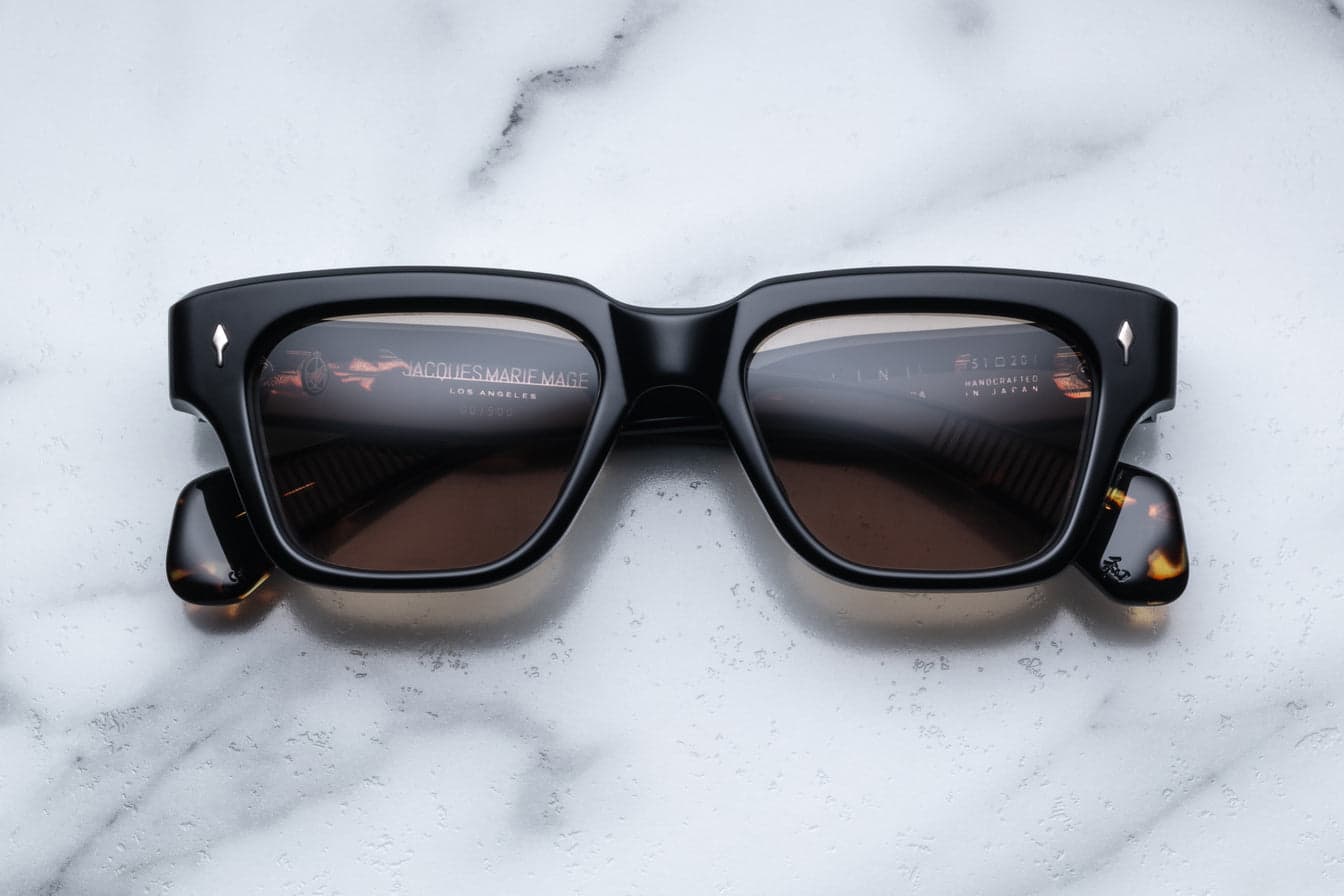
I've fit all three of these brands in the same week, on the same face, more than once. The question of which is "best" is the wrong question. Lindberg, Jacques Marie Mage, and DITA are three luxury brands that come up constantly, and they don't compete with each other as much as new buyers think they do.
This comparison is for the person deciding where to put their next $800-$1,500. I'll tell you which brand I'd put on which face — and which one I'd talk you out of.
Quick Answer — the one-sentence version
Lindberg if weight and engineering matter more than visible design; Jacques Marie Mage if you want the frame to be a conversation piece with cinematic backstory; DITA if you want the hybrid titanium-acetate construction at a lower entry price than JMM.
That's the shortcut answer. The rest of this post is the detail, because the three brands diverge sharply once you move past generalities — on materials, on production scale, on who should own them, and on whether the company has the same DNA it had five years ago.
Lindberg — what you're actually buying
Lindberg's whole proposition is that the frame should disappear. No visible screws. No visible hinges. No visible welds. The construction is held together by tension and geometry rather than hardware, and the titanium is milled in-house in Aarhus, Denmark, where the brand is still headquartered.
The Air Titanium Rim line is the one that put Lindberg on the map — full-rim titanium frames that weigh 2-4 grams. The Strip 9000 series is full rimless and weighs under 2g in some sizes.
Retail starts around $650 for adult titanium optical, most of the titanium lineup runs roughly $650-$900, and buffalo-horn models run about $2,400-$2,560; ask your optician for current pricing on precious-metal pieces. Kering acquired Lindberg in 2021, which caused some hand-wringing, but Lindberg is still headquartered in Aarhus, Denmark.
Where Lindberg wins: daily wear, long hours, anyone who forgets they're wearing glasses. Patients with skin sensitivity — the titanium is genuinely hypoallergenic. Anyone who wants the frame to not be the thing people comment on.
Where Lindberg loses: if you want eyewear as personal expression. Lindberg styling is deliberately quiet. The company has experimented with color and horn, but the DNA is restraint. It's the best tool for the job, not the most fun object to own.
Jacques Marie Mage — small-batch cinematic acetate
Jerome Mage founded JMM in Los Angeles in 2015 with one rule: each model is a cultural reference, produced in limited runs, named after someone who mattered. The Dealan (Bob Dylan), Molino (Fellini's cinematographer), Torino (Lavazza), Zephirin, Enzo, Fellini, Yves — every model has a story, and the story is part of the purchase.
Production is Japanese acetate assembled in Fukui workshops. Runs are limited. Once discontinued, they're gone, and rare colorways can trade above retail on Grailed and collector forums.
Retail starts at $985 for basic optical (Enzo, Molino), runs roughly $905-$1,270 for most in-stock sunglass styles, and past $2,000 for limited and collector editions. The acetate itself is worth mentioning — it's thick (6-8mm), hand-polished, and typically Mazzucchelli from Italy.
Where JMM wins: personal expression, collector value, resale market, the joy of owning something rare. Anyone who wants their frames to be the first thing people notice.
Where JMM loses: weight (most models are 25-35g, which is a lot after six hours), daily comfort, narrow fitting ranges (JMM sizing is European-assumptive, so American faces with wider bridges often struggle). JMM is also not the pair to bring to a titanium engineer who wants to understand why a frame costs nearly $1,000.
DITA — the hybrid that started the category
DITA launched in 1995 in Los Angeles with a specific idea: hybrid construction, titanium cores sheathed in Japanese acetate, producing frames that read as acetate but engineer like titanium. For two decades they were the benchmark for "luxury eyewear that looks cinematic but fits engineered." Think Leonardo DiCaprio and the Mach-Six.
DITA was founded in Los Angeles in 1995 by Jeff Solorio and John Juniper, who later left the brand and now design for the Akoni Group (founded by Rosario Toscano and Salma Rachid) and Robert Marc. Current DITA keeps the same construction language, but in my view the brand feels different — more polished, less personal.
Retail is $500-$1,200 for most optical and sun frames (confirm current pricing with the brand), which is notably lower than JMM. The Mach series, Statesman, and Aristocrat lines are still the signatures. Build quality is still excellent; the question is whether the DNA is still there.
Where DITA wins: hybrid construction at a lower entry price than JMM. Anyone who wants titanium durability with acetate aesthetics. The current DITA lineup is also genuinely more consistent in fit — fewer wild sizing outliers than JMM.
Where DITA loses: if you cared about DITA specifically because of its original designers, Jeff Solorio and John Juniper have left; they now design for the Akoni Group and Robert Marc. The current lineup leans slightly more conservative, which may disappoint long-time fans.
Comparison table — the direct face-off
| Dimension | Lindberg | Jacques Marie Mage | DITA |
|---|---|---|---|
| Founded | 1986 | 2015 | 1995 |
| HQ | Aarhus, Denmark | Los Angeles, USA | Los Angeles, USA |
| Production | Denmark | Japan (Fukui) | Japan |
| Primary material | Titanium, horn | Japanese acetate | Titanium + acetate hybrid |
| Typical weight | 2-5g | 25-35g | 20-30g |
| Retail range | $650-$900 titanium; horn $2,400+ | $985-$1,385 core; limited $2,000+ | $500-$1,200 |
| Production scale | Industrial (quiet) | Limited runs | Industrial |
| Resale value | Varies | Strongest of the three (limited editions) | Varies |
| Ideal wearer | All-day, comfort-first | Style-first, collector | Hybrid enthusiast |
| Boutique-fit required | Yes (specialized) | Yes (JMM-trained) | Yes (moderate) |
| Current ownership | Kering (2021) | Independent | Privately held (DITA, Inc., California) |
The fitting experience — what actually differs
Here's the part the spec sheets don't capture. All three brands require skilled boutique fitting, but the fitting experience is different.
With Lindberg, the technician has to know Lindberg's specific tools. Screwless construction means adjusting a Lindberg is nothing like adjusting a standard titanium frame — you're working with tension and memory, not screws. A Lindberg boutique typically has a factory-trained fitter, and the initial fitting runs 30-45 minutes. Follow-up adjustments are unusual once the fit is dialed in.
With JMM, the frame is heavier and the acetate is thicker, which means heat-adjustment is more involved. JMM sizes aren't always consistent between models — the Dealan, for example, is cut for a narrower bridge than the Molino. Boutiques that carry JMM usually have multiple sizes of the popular models on the floor so the fitter can compare geometry. Allow 45 minutes.
With DITA, the hybrid construction means you can do both heat-adjustment (on the acetate) and tension-bend (on the titanium core). This is both an advantage and a risk — more adjustment surface, more ways to get it wrong. A good DITA fitter will get it right the first time. A less experienced one will over-adjust and the frame will feel wrong in a week.
Which one for which wearer
For the practical wearer (offices, long hours, comfort-first): Lindberg. Every time.
For the style-first wearer (social, photographed, eyewear as personal expression): Jacques Marie Mage.
For the hybrid wearer (wants acetate aesthetics, titanium durability, moderate budget): DITA, or consider Akoni, where DITA's original designers now work.
For the collector (cares about rarity, resale, limited editions): Jacques Marie Mage, no other choice.
For the first-time luxury buyer (has never spent over $500 on frames): Lindberg, surprisingly. The engineering justification is concrete and lasting, which makes the first big-ticket purchase easier to rationalize than the JMM "story premium."
Where to try them
You're not going to find these three side-by-side at a chain optical. Here's where I'd send someone:
- Gazal Eyecare in Roswell, Georgia — Atlanta-area; rotating JMM and Lindberg inventory, Akoni regularly stocked.
- Blinka Optical in Geneva, Illinois — Chicago-area; strong JMM and Lindberg combined presence.
- L'Optique in Asheville, North Carolina — mountain region; DITA and Lindberg, wider rotation of European brands.
- Specs Around Town in Bloomington, Illinois — Central-Illinois luxury boutique with a deep Lindberg focus.
For the complete independent luxury boutique directory, use the practice locator and filter by brand.
The bottom line
Between Lindberg, Jacques Marie Mage, and DITA, there is no "best." Each one was built for a different wearer. Lindberg is engineering as luxury — the frame disappears and you forget it's there. JMM is craft as luxury — the frame is the thing, and the story matters. DITA is hybrid construction as luxury — titanium where you need it, acetate where you want it.
My actual recommendation, if you're staring at all three in the same boutique and can't decide: try the Lindberg first. If it feels right, stop. If you want more personality, try the JMM. If you want something in between, try the DITA — or look at Akoni, where DITA's original designers now work.
And don't buy online. These are three of the brands that justify a 45-minute boutique fitting most. Find an independent luxury boutique and plan an unhurried visit.
Frequently Asked Questions
Which brand has the highest resale value?
Resale values vary widely; limited-edition JMM pieces are the most likely of the three to hold value. If resale matters, limited-edition JMM is the strongest candidate of the three.
Which is the most comfortable for all-day wear?
Lindberg, without exception. Frames in the Air Titanium Rim line weigh 2-4 grams. DITA and JMM frames typically weigh 20-35 grams. If you wear frames 8+ hours a day, the weight difference is the deciding factor — you can feel it by 2 PM.
Is DITA still worth buying today?
Yes, with a caveat. Current DITA frames keep the titanium-acetate construction. But original designers Jeff Solorio and John Juniper have left the brand; they now design for the Akoni Group and Robert Marc. If their design hand is what you want, look at Akoni as well as DITA.
Which one looks best on a round face?
JMM and DITA both lean toward angular, cinematic shapes that break up round-face softness — the Dealan, Molino, Enzo, and Torino models all work. Lindberg's minimalist round shapes can amplify round faces unless you stick to their angular square and rectangle styles.
Are Lindberg frames really only 3 grams?
The rimless Air Titanium 1.7 line hits 1.9 grams for smaller sizes. Standard Air Titanium Rim models run 2.5-4 grams. Horn, precious, and acetate Lindberg models are heavier (8-15g) but still well under the 20-30g industry norm. The weight is real — not marketing.
Do all three require a boutique fitting?
Functionally yes. Lindberg's screwless construction requires specific adjustment tools and training. JMM's custom-sized Japanese acetate can't be heat-adjusted by anyone who hasn't been trained on it. DITA is slightly more forgiving but still benefits from boutique-level fitting. None of the three will be fitted correctly at a chain optical.
Newsletter
Independent eyewear, in your inbox
Monthly stories on the world's finest independent eyewear brands and boutiques.
Related Reading
Jacques Marie Mage Glasses: Models and Prices (From $985)
Jacques Marie Mage optical frames start at $985, with core models $985-$1,385, made in limited runs. See signature models, prices and why rare ones resell.
Brands Like Chrome Hearts: 7 Eyewear Alternatives for Metal, Heft and Rarity
Looking for eyewear like Chrome Hearts? Seven alternatives compared by what draws people to CH: precious-metal detail, heavy acetate, limited runs, and price.
Kuboraum Spotlight — The Berlin Mask Eyewear Made by Hand in Italy
Kuboraum turns eyewear into sculpture — thick, oversized acetate "masks" dreamed up in Berlin and hand-finished in a small workshop in northeastern Italy. Here's the real story, not the marketing gloss.
Comments
0 comments · moderated
No comments yet. Be the first to weigh in.