
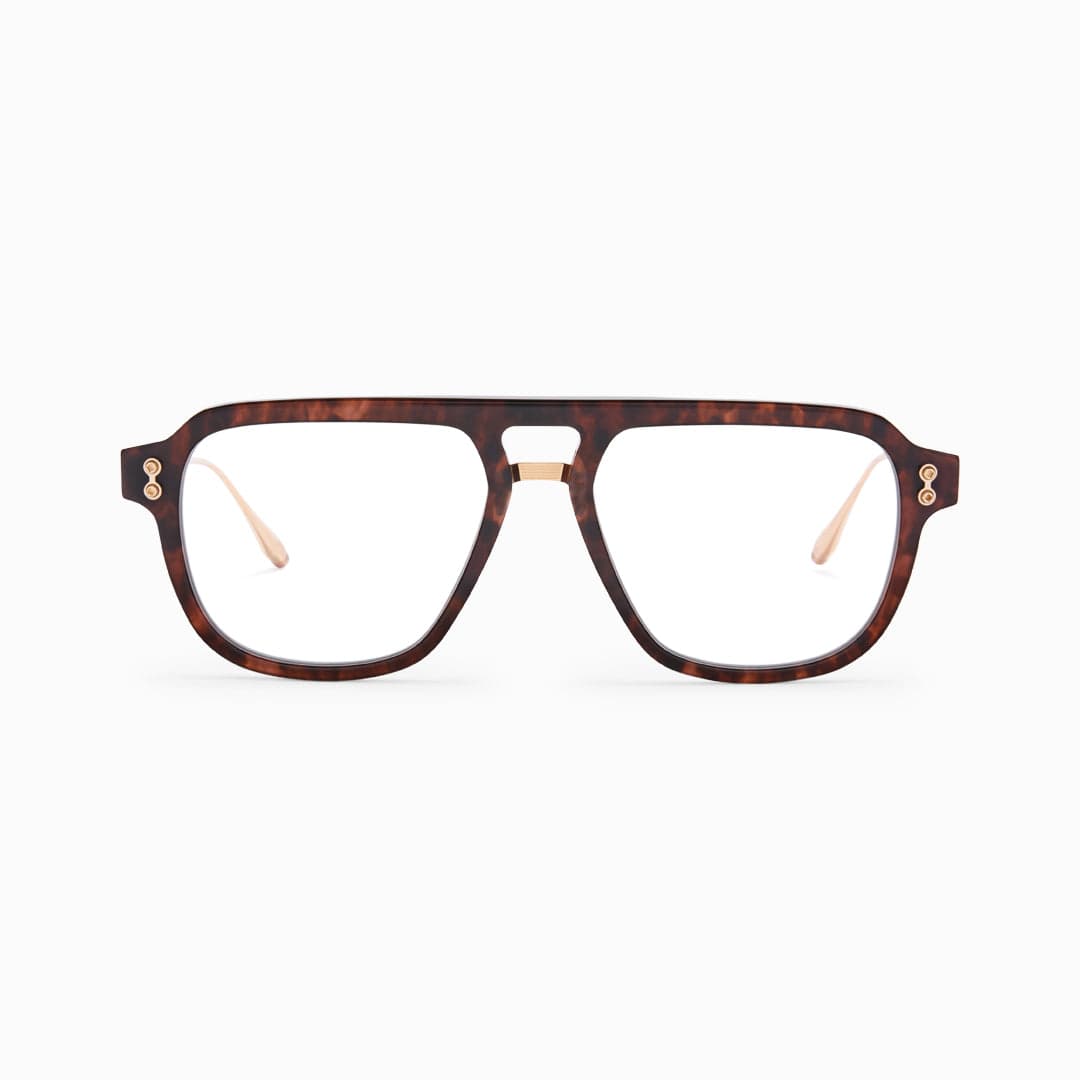
Akoni frames share the Japanese-titanium craft approach associated with DITA, which is unsurprising since founder Rosario Toscano previously led DITA as global managing director. It isn't a copy; it's someone who knew that world building his own version of it.
Today Akoni is a common boutique-optician recommendation when a customer wants Japanese-titanium quality with a quieter brand story. The brand has built a small but real following among boutique-optical professionals.
Quick Answer — what Akoni is
Akoni is a Japanese-titanium-focused independent luxury eyewear brand founded in Lugano, Switzerland by Rosario Toscano, a 20+ year luxury-eyewear industry veteran, and creative director Salma Rachid. The brand emphasizes restrained architectural design, titanium construction, and deliberate scarcity. Retail runs roughly $575-$1,190+, with most models clustering $700-$1,100.
The origin — a real industry veteran, not a DITA spinoff
Akoni's founder, Rosario Toscano, is a genuine luxury-eyewear industry veteran — 20+ years in the business, including a stint as global managing director at DITA. He co-founded Akoni with creative director Salma Rachid.
That's worth being precise about, because a persistent misconception (one this post previously repeated) has Akoni founded by DITA's founders. DITA was founded in 1995 by Jeff Solorio and John Juniper; they did not found Akoni, though reports say they collaborated on its first collections. Toscano's connection to DITA is on the business side, not as one of its founders.
The name "Akoni" means "noble" in Hawaiian — a name choice that signals quiet confidence rather than loud branding, which carries through the product.
The design language
Akoni frames lean architectural. Not ornamental, not cinematic — architectural. Clean titanium geometry, hinges integrated rather than exposed, minimal visible branding (a small "A" on the temple tip, not a huge logo).
The signature construction is "thin titanium with acetate accents." The titanium does the structural work; the acetate provides visual softness at the brow line or temples. It's the exact inverse of a traditional acetate frame with titanium reinforcement — and the result is a frame that feels light for its visual presence.
Akoni draws on DITA-adjacent talent, so a lot of its models sit in a similar Japanese-titanium design space — not surprising given the founder's background in that world. The Zenith and Hercules models push further into their own territory — architectural square optical and aviator sun shapes.
Signature models — a field guide
- Wise (optical) — mid-size polished titanium optical. The most-requested Akoni in our practice. About $775-$860.
- Zenith (optical) — architectural square. Slightly larger, bolder. $650-$750.
- Iris (optical) — refined round with subtle metal detailing. Suits professional wear. $600-$700.
- Swift (optical) — smaller optical, narrower bridge. Good for more petite faces. About $840-$910.
- Solis (suns) — mid-size polarized-capable sunglass. The most versatile Akoni sun. About $1,090-$1,190.
- Hercules (suns) — bold aviator-adjacent sun, larger lens. About $840-$910.
- Stargazer (suns) — squarer sunglass silhouette with titanium trim. About $865-$950.
- Pathfinder (suns) — bigger, more sport-adjacent aviator. About $975-$1,080.
- Sprint-A (suns) — active-adjacent wraparound with titanium precision. About $975-$1,080.
- Echo (suns) — sleek modern sun with thin titanium frame. About $865-$950.
Most boutique opticians that carry Akoni stock 8-15 models at a time. The full catalog is broader (20+ models) but inventory rotates.
The fit — where Akoni surprises
One quiet note we've observed fitting patients: Akoni sizing tends to run a bit wider and longer in the temple than some European-designed titanium lines.
Practically, what this means: if you have a wider bridge (most American wearers of European descent plus many wearers with Asian, Indian, and African heritage), Akoni fits better than Lindberg's standard sizing — Lindberg's Air Titanium Rim is cut to European geometry. Akoni accommodates wider faces without needing custom sizing.
We've fit more Akoni than we expected to at Gazal Eyecare for exactly this reason. The geometry works for patients whose faces don't fit the European norm.
The price tier — where Akoni sits
Akoni's real retail range runs roughly $575 to $1,190+, with most models clustering $700-$1,100 — positioned as a luxury Japanese-titanium line, not a budget alternative.
Within that range, Akoni's value case is straightforward: Japanese-made titanium with a quieter, less Hollywood-branded identity, from a founder with real hands-on experience in that segment of the industry.
Where to try Akoni
Akoni is not at chain opticals. Distribution is deliberately limited. A few boutiques that carry it:
- Gazal Eyecare in Roswell, Georgia — rotating Wise, Zenith, and Solis inventory.
- Blinka Optical in Geneva, Illinois — Chicago-area Akoni dealer.
- Bixby Eye Center in Peoria, Illinois — central-Illinois Akoni rotation.
- L'Optique in Asheville, North Carolina — broader European rotation, often with Akoni paired.
Call ahead — Akoni stock turns fast, and specific colorways and sizes are limited. The full boutique practice locator lists other authorized dealers.
The bottom line
Akoni is a quiet-luxury titanium pick from a founder with real, hands-on luxury-eyewear industry experience — DITA-adjacent talent, frames made in Japan, a quieter brand story, and a brand still small enough to feel personal rather than mass-market.
If you're weighing Akoni against Lindberg: Lindberg is lighter and more engineered, Akoni is more architectural. If you're weighing Akoni against JMM: Akoni is titanium-first (daily comfort), JMM is acetate-first (design statement).
For a first real Japanese-titanium luxury pair, Akoni is one of the smarter choices in the market. The material is honest, the engineering is real, and the boutique experience — where you'll actually buy it — makes the whole purchase make sense. Find a boutique that carries Akoni and plan an afternoon visit.
Frequently Asked Questions
Is Akoni founded by the DITA founders?
No. Akoni was founded by Rosario Toscano, who spent 20+ years in luxury eyewear including a stint as DITA's global managing director, and Salma Rachid, its creative director. DITA's founders, Jeff Solorio and John Juniper, did not found Akoni, though reports say they collaborated on its first collections. The design overlap you can sometimes feel between the two brands comes from that shared talent and Toscano's DITA experience, not from Akoni being run by DITA's founders.
How is Akoni different from DITA?
Akoni is quieter — less Hollywood, more architectural. Distribution leans boutique, though Akoni also sells direct through its own site rather than being boutique-exclusive. Styling shares some DNA (both draw on Japanese-titanium construction), but Akoni reads as more restrained.
Are Akoni titanium frames Japanese-made?
Yes. The titanium construction runs through the Japanese-titanium supply chain the boutique-optical tier generally draws from. It's the material quality you'd expect at this price tier.
What's the best Akoni for a first-time buyer?
The Wise optical or the Solis sunglass. Both are mid-size (the Wise runs about $775-$860, the Solis about $1,090-$1,190), use polished titanium with accent acetate, and fit a broad range of faces. Start here before moving to the heavier Hercules or the architectural Zenith.
How does Akoni compare to Lindberg on comfort?
Lindberg is lighter (2-5g for most models) than Akoni (15-25g). But Akoni titanium has more visual presence — Lindberg is deliberately invisible, Akoni is deliberately architectural. For a wearer who wants titanium comfort but also wants the frame to read as a design object, Akoni wins.
Where can I try Akoni in person?
Akoni is sold through a limited network of boutique opticians, and also direct through akoni.com. The [boutique practice locator](/boutique-practice-locator) lists authorized dealers. Call ahead to confirm stock — Akoni inventory is small, and boutiques typically carry 8-15 models at a time.
Newsletter
Independent eyewear, in your inbox
Monthly stories on the world's finest independent eyewear brands and boutiques.
Related Reading
Lindberg Spotlight: Why Danish Titanium Became the Industry Benchmark
A deep look at Lindberg eyewear — the Aarhus-based brand whose screwless titanium frames weigh under 2 grams and set the standard luxury opticians measure against.
Akoni vs Masunaga — Two Very Different Takes on Japanese Titanium
Akoni is a Swiss-branded newcomer using precision Japanese titanium. Masunaga is the 120-year-old Sabae house that helped build the industry Akoni sources from. Here's how they actually compare.
Lunor Spotlight — The German Rimless House Built by an Antique Collector
Lunor's riveted, screw-free hinge and gold rimless frames trace back to one Stuttgart optician's collection of antique eyewear. Founded 1991, made in Germany's Black Forest, roughly $600-$1,000 retail.
Comments
0 comments · moderated
No comments yet. Be the first to weigh in.