Most mainstream eyewear brands on the high street come from a handful of large groups, led by EssilorLuxottica, which is commonly estimated at roughly a quarter of eyewear sold worldwide — Ray-Ban, Oakley, Persol, Prada, Versace, Burberry, even a lot of what reads as "designer" at chain opticals. The frames are fine. But they are not what this list is about.
This list is about the brands that design their own frames, own their own materials, and answer to their own founders. The brands where a colorway change still has to be approved by the person whose name is on the temple. Below is my ranked edit of the independent luxury eyewear brands worth your $500-$3,000 in 2026 — by material honesty, craft, and the likelihood that your pair still looks right in 2036.
Quick Answer — what makes a luxury eyewear brand actually luxury
Price is the lazy answer. The real markers: who owns the company, where the raw material comes from, how many humans touch each frame, and whether the design team could tell you the name of the factory floor lead. Brands that clear all four are a tiny percentage of the market. I've tried to include every one I'd personally stock.
A second marker is availability. Real luxury eyewear doesn't sit in a chain-store display next to the Oakleys. Most of the brands below are only carried by independent optical boutiques — practices that book 45-minute fittings, take prescriptions seriously, and have staff who have been to the factory. If you've never bought from a boutique, the last section of this post points you to ours.
The 2026 ranking
1. Lindberg — the Danish titanium benchmark
Lindberg began as Poul-Jørn Lindberg's optical store in Aarhus, Denmark (1969); the screwless Air Titanium frame launched in 1986. Some models weigh under 3 grams, and the Spirit comes in at 1.9 g.
Kering Eyewear acquired Lindberg in 2021 (completed October 2021); the brand says it still designs and manufactures in Denmark. Standard titanium Air, Spirit, Strip and N.O.W. builds run roughly $650 to $850 at retail, and buffalo-horn models start around $2,400. The sweet spot is the Air Titanium Rim range, roughly $650-$850.
Honest take: the styling is quiet. Lindberg will never be the frame someone asks about at dinner. That is either the point or the disqualifier, depending on the wearer. My rule: if you want people to notice the frame, skip Lindberg. If you want the frame to disappear while your face does the work, nothing else comes close.
See our full Lindberg spotlight.
2. Jacques Marie Mage — small-batch Japanese-made acetate from LA
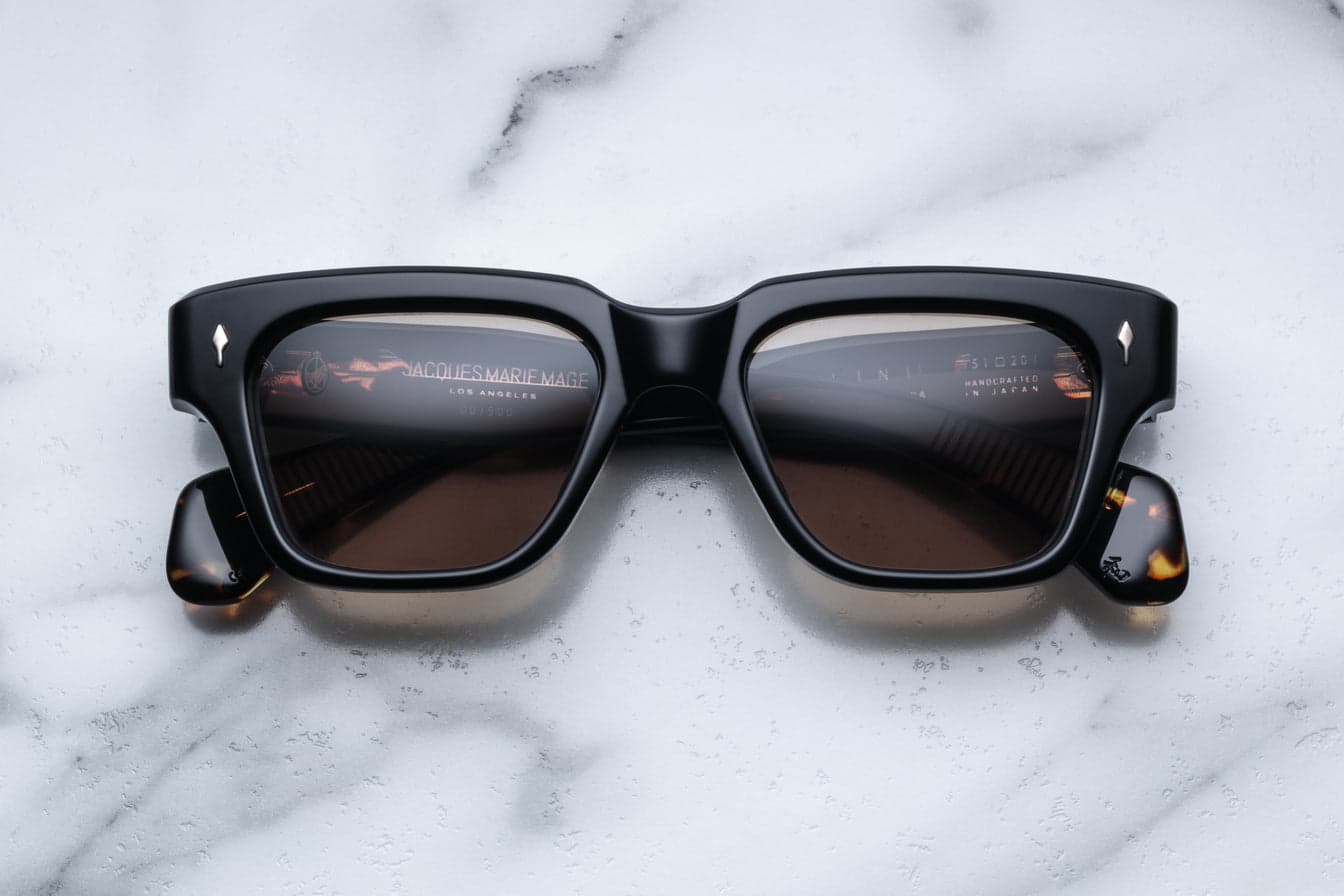
Jerome Mage started Jacques Marie Mage in 2015 in Los Angeles with a Hollywood-meets-Paris obsession. Every model is named after a cultural figure (Dealan after Bob Dylan, Molino after architect Carlo Mollino, Torino after the Teatro Regio Torino opera house) and runs in limited batches per colorway. Once they're gone, they're gone.
Production is hand-finished and made in Japan and Italy in limited runs. Optical frames start at $985, core models run $985-$1,385, and limited editions climb past $2,000. Some discontinued colorways resell above retail.
Controversial opinion: JMM's recent pivot into heavy gold hardware is a mistake. The quiet hand-polished Japanese acetate is the whole brand. When they lean on sparkle, they start to look like the Italian mass-market luxury they were supposed to replace.
3. Chrome Hearts — sterling silver from a Los Angeles house
Richard Stark founded Chrome Hearts in Los Angeles in 1988, with partners, as a silversmithing and leather workshop. The eyewear carries real sterling-silver hardware with engraved cross or fleur-de-lis signatures, and is primarily produced in Japan. That silver is why the frames weigh like jewelry.
Retail starts around $1,200 (acetate with silver temples) and climbs past $3,000 for the fully silver pieces. There's a waiting list for some models. Most boutique opticals can't even carry the brand — Chrome Hearts decides who gets distribution, and it's a short list.
Honestly, Chrome Hearts isn't for everyone. The aesthetic is loud, the price is brutal, and the silver needs real care. It's the closest thing to buying a piece of jewelry that happens to sit on your face.
4. Akoni — quiet-luxury titanium from a DITA veteran
Rosario Toscano, a 20-plus-year luxury-eyewear industry veteran who served as DITA's global managing director (not one of DITA's founders — those are Jeff Solorio and John Juniper, who have since collaborated with Akoni on design), co-founded Akoni with Salma Rachid. The brand philosophy is exactly what you'd expect from that background: architectural Japanese titanium, subtle detailing, restraint. Retail runs $575-$1,190+ — still below JMM while matching or exceeding the material spec.
Their Wise, Zenith, Hercules, and Stargazer models sit in our Gazal Eyecare cases because the titanium temples are comfortable on wider Southern heads, and the bridge geometry actually works for lower nose bridges. That's a specific clinical reason, not marketing — we've fit more Akoni frames this year than we expected to.
I think Akoni is where the DITA faithful go now. The price is better. The styling has matured past DITA's late-2010s gold-plated moment.
5. Anne et Valentin — Toulouse color theory worn daily
Anne et Valentin started as an optical shop in Toulouse in the early 1980s, with the first eyewear collection under the Anne et Valentin name following in 1984. Every Anne et Valentin frame is an experiment in color combination — Pantone values that other brands would reject as "unwearable" stacked on faces in a way that somehow works. The acetate is French, Jura-region material; we're not asserting a specific named mill without independent confirmation.
Retail roughly $385-$715, most around $430-$620. The French design vocabulary is specific: asymmetry, unexpected temple shapes, and colors that shift depending on the wearer's skin temperature. If you've never worn bold frames, Anne et Valentin is a gentler on-ramp than Chrome Hearts or Kuboraum.
6. A different material story — Nina Mûr
Nina Mûr is a Madrid studio founded in 2018 by designer Lorena Serrano. Frames are genuinely handmade from laminated layers of Finnish birch plywood with metal hardware — not acetate. Small studio, small team, unpredictable release calendar, and a genuinely different material story than almost anything else on this list.
Retail $350-$550. This is the "found you on Instagram" brand of 2026, but the material substance backs it up — real wood construction is rare in independent eyewear.
7. Maui Jim — polarized performance, Hawaiian origin
Controversial inclusion on a luxury list, because Maui Jim (part of Kering Eyewear since 2022) sells at mass price points ($199-$450) and is distributed broadly. But the PolarizedPlus2 lens is genuine performance technology, and in our view it handles color under mixed light better than most polarized lenses. For anyone who's on the water, driving long distances, or skiing seriously, the lens is worth the brand.
Frames are nylon and titanium, decent but not the story. Buy Maui Jim for the lens, not the frame. And buy from a boutique where the fitting is done properly — the lens benefits evaporate if the frame doesn't sit right.
8. Gazal Eyewear — Southern craftsmanship, European line
Full disclosure: this is our house brand. Gazal Eyewear is designed at Gazal Eyecare in Roswell, Georgia and produced in premium Italian acetate. Every frame starts its life as a measurement pattern — taken from real patient faces at the practice — before it's cut. Bridges are wider, temples are longer, and we specifically design for the faces that don't fit European-sized luxury eyewear off the rack.
Retail $400-$1,200, which starts below Lindberg, Akoni, and the top-tier brands above. The proposition is simple: Italian acetate at an honest price, with fit data from clinical optometry built into the geometry. Available at Gazal Eyecare in Roswell, Georgia and a handful of other partner practices.
Comparison table — the 2026 at-a-glance
| Brand | Country | Materials | Retail range | What you're paying for |
|---|---|---|---|---|
| Lindberg | Denmark | Titanium, horn | $650-$900 titanium, $2,400+ horn | Sub-3g screwless engineering |
| Jacques Marie Mage | USA/Japan | Acetate, titanium | $985-$1,385 core; limited $2,000+ | Small-batch rarity, cinematic storytelling |
| Chrome Hearts | USA | Sterling silver, acetate | $1,200-$3,000+ | Sterling-silver hardware, LA design |
| Akoni | Switzerland | Japanese titanium | $575-$1,190+ | Precision-engineered by a DITA-industry veteran |
| Anne et Valentin | France | Acetate | $385-$715 | Unexpected color combinations |
| Nina Mûr | Spain | Finnish birch plywood | $350-$550 | Hand-made Madrid studio, genuine wood construction |
| Maui Jim | USA | Titanium, nylon | $199-$450 | PolarizedPlus2 lens technology |
| Gazal Eyewear | USA | Acetate, titanium | $400-$1,200 | Clinical fit data, premium Italian acetate |
Where to try them
These brands don't sell at chain opticals. Your nearest boutique optical practice is the way in. A few of ours:
- Gazal Eyecare in Roswell, Georgia — Gazal, Akoni, and a rotating lineup of Kuboraum and JMM.
- Blinka Optical in Geneva, Illinois — curated independent selection with strong JMM and Lindberg inventory.
- Bixby Eye Center in Peoria, Illinois — central-Illinois luxury boutique with Akoni and Lindberg focus.
- L'Optique in Asheville, North Carolina — mountain-region destination for Anne et Valentin and Nina Mur.
- Specs Around Town in Bloomington, Illinois — Midwestern independent with a deep Lindberg focus.
Or browse the full boutique practice locator to filter by brand or state.
The bottom line
The best luxury eyewear in 2026 is still made in the same handful of European and Japanese workshops that were making it in 2016. What's changed is the cost of entry — there are now more ways into serious independent eyewear under $600 than ever, with Akoni, Anne et Valentin, Nina Mur, and Gazal Eyewear all offering premium frames under $700. From about $1,000 up, Chrome Hearts and Jacques Marie Mage are in a category of their own.
If you're starting your first independent pair, don't start with Chrome Hearts. Start with something you'd still wear daily at $500-$700, let it age a year, then decide whether you want to climb. And try the frames in person — the luxury part of luxury eyewear is the way it sits on your face, and no amount of online browsing replaces a 45-minute boutique fitting.
Looking to try these in person? Find an independent luxury boutique near you.
Frequently Asked Questions
What makes an eyewear brand 'independent' in 2026?
Independent brands are owned and operated outside the large eyewear groups (EssilorLuxottica, Safilo, Kering Eyewear, LVMH Thelios, Marcolin and others). They typically design in-house, source their own materials, and produce in limited runs. Ownership transparency is the fastest test — if you can name the founder and they still approve colorways, it's independent.
Is paying over $500 for frames ever worth it?
Yes, when the premium buys material honesty (Japanese titanium, premium Italian acetate, real horn), hand-finishing, and precision that lasts a decade. A $900 Lindberg or $650 Akoni frame typically outlives three pairs of $250 chain-store frames and holds resale value. Below $400, most 'luxury' branding is marketing paint on the same Chinese-made metal.
What's the difference between Jacques Marie Mage and Chrome Hearts at the high end?
Jacques Marie Mage is small-batch Japanese-made acetate (from $985, limited editions $2,000+) with cinematic storytelling behind each model. Chrome Hearts uses sterling silver hardware on frames primarily produced in Japan ($1,200-$3,000+), and sits closer to jewelry than eyewear. Collectors buy JMM for the craft and Chrome Hearts for the provenance and metal weight.
Which brand has the best lens technology?
In our view, Maui Jim's PolarizedPlus2 is the polarized sunglass benchmark for color and glare control under mixed light. For optical (prescription) lenses, Zeiss and Essilor lead on digital-lens precision, but those are lens brands, not frame brands.
Where can I try these brands in person?
Most independent luxury brands are distributed only through boutique opticals — not chain stores. Use the View Eyewear boutique practice locator to find the nearest one by zip code or brand filter. Most boutiques book unhurried 45-minute fittings that chain stores cannot match.
How often do independent brands release new models?
Twice a year is typical — spring/summer (March-May) and fall/winter (September-November). Small-batch brands like Jacques Marie Mage and Chrome Hearts also drop limited 'capsule' releases mid-season that sell out within days of reaching boutiques.
Newsletter
Independent eyewear, in your inbox
Monthly stories on the world's finest independent eyewear brands and boutiques.
Related Reading
Brands Like Chrome Hearts: 7 Eyewear Alternatives for Metal, Heft and Rarity
Looking for eyewear like Chrome Hearts? Seven alternatives compared by what draws people to CH: precious-metal detail, heavy acetate, limited runs, and price.
Lunor Spotlight — The German Rimless House Built by an Antique Collector
Lunor's riveted, screw-free hinge and gold rimless frames trace back to one Stuttgart optician's collection of antique eyewear. Founded 1991, made in Germany's Black Forest, roughly $600-$1,000 retail.
Best Luxury Sunglasses Brands of 2026: Lens-First Picks
The best luxury sunglasses brands for 2026, chosen lens first: Maui Jim for polarized glare control, Jacques Marie Mage and Akoni for frames, plus tint and VLT basics.
Comments
0 comments · moderated
No comments yet. Be the first to weigh in.