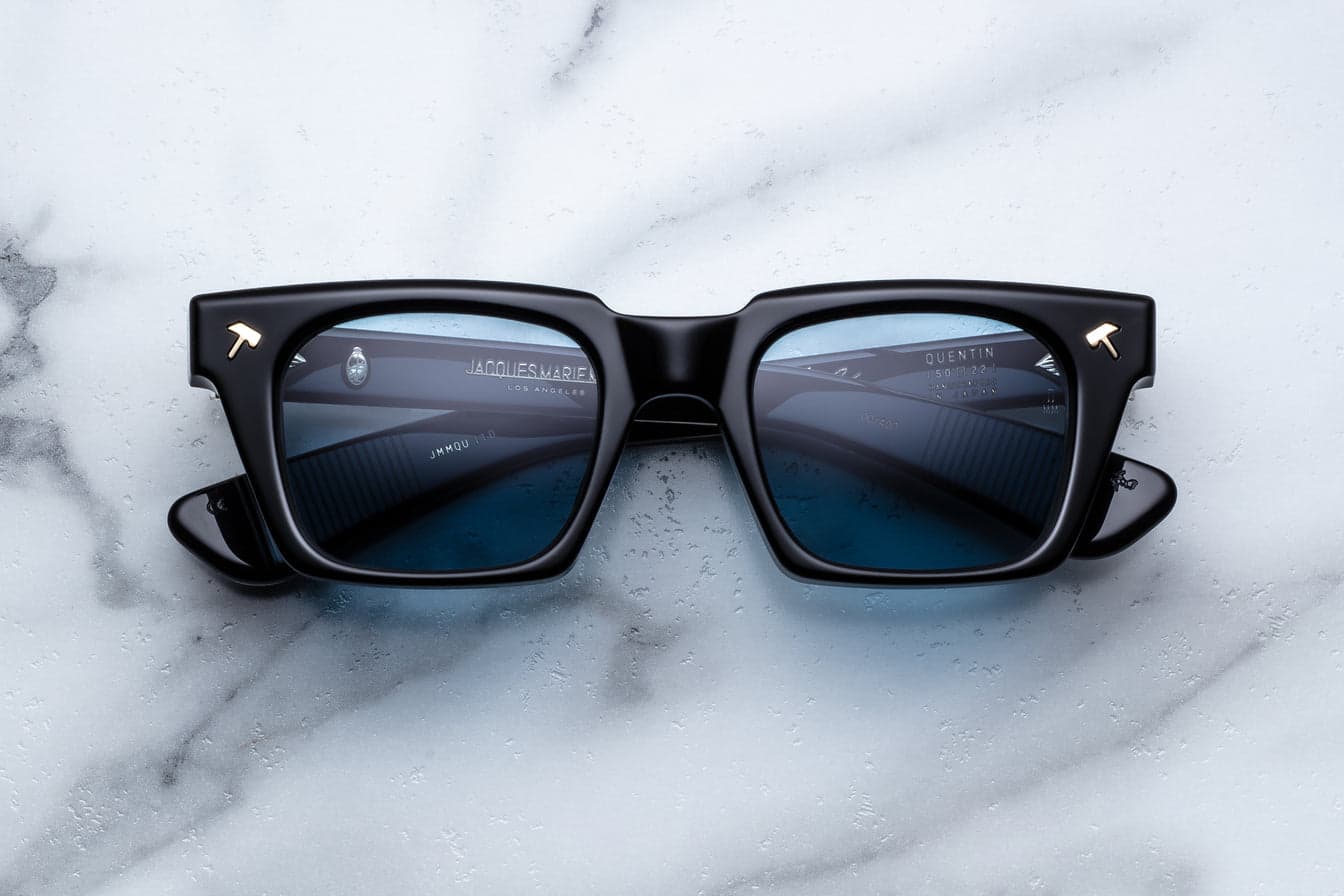
A common mistake is following online advice that round faces "need cat-eye." A soft, round face with high cheekbones and a strong nose can look wrong in cat-eye frames — not because cat-eye is wrong, but because those specific proportions need something else, such as a sharper acetate square like the Jacques Marie Mage Torino in a warm tortoise.
The internet's version of face-shape advice is usually wrong because it treats faces as categories instead of specific geometries. Round faces aren't all the same. But there is a durable general rule: round faces benefit from angular frames most of the time. This post is the playbook — what square frames actually work, why, and which brands get the proportions right.
Quick Answer — the five frames I'd pull first
For a round face walking into Gazal Eyecare for the first time, the square-frame shortlist I actually grab:
- Jacques Marie Mage Torino — thick Japanese acetate, sharp square, $985
- Anne et Valentin Brooklyn — sculptural angular acetate, about $495, within the brand's roughly $385-$715 range
- Akoni Zenith — architectural titanium square, within the brand's $575-$1,190+ range
- Gazal Eyewear "The Man" — mid-range acetate square, about $525-$550, within Gazal's $400-$1,200 range
- Lindberg n.o.w. angular series — titanium square at the quieter end, roughly $655-$840
Each of these serves a slightly different wearer and price tier. The rest of this post is the why.
The face-shape rule — and where it breaks
The classical rule: faces and frames work by contrast. Soft faces get angular frames. Angular faces get softer frames. Round + round amplifies. Round + square contrasts and balances.
That rule is right most of the time. It breaks in specific cases:
- Very small round faces with fine features — extreme angular frames can overpower. Softer angular shapes (modified square, rounded rectangle) work better than sharp geometric squares.
- Taller round faces — rounds become viable because the face's height already provides some visual definition.
- Round faces with strong features (prominent nose, strong brow) — the features themselves provide angular contrast; round frames become a wearable option.
- Older faces — as faces change with age, softer angular frames often flatter more than sharp geometric shapes.
For most round-faced wearers, though, the rule holds. Angular = contrast = definition.
The proportion rule — the thing most guides miss
Most face-shape guides tell you what shape to buy but don't tell you what size. That's backwards — size matters more than shape category for round faces specifically.
Here's the rule: your frame's total horizontal width should be slightly wider than your face's widest point (usually cheekbones). "Slightly wider" means 5-10mm wider, not dramatically so.
Why this works: round faces are characterized by width at the middle (cheekbones) and softness at the edges. A frame that's narrower than your cheekbones gets visually dominated by the face. A frame slightly wider than the cheekbones introduces a new visual edge that creates definition. An oversized frame (15mm+ wider than cheekbones) dominates the face entirely, which sometimes works but often looks costume.
Measure your face width with a ruler — forehead, cheekbones, jaw — to find the widest point. Then fit to 5-10mm above that measurement.
The frame details that matter
Beyond overall size, specific frame details move the needle on round faces:
- Defined brow line. A clear upper frame bar reads as horizontal structure and breaks up the face's softness. Avoid rimless or bottom-rim-only frames unless the optical is heavily specific.
- Sharp corners, not rounded. Square frames with slightly rounded corners lose the contrast effect. Look for frames where the corners are actually corners.
- Moderate to thick acetate, not thin wire. Acetate frames (JMM, Anne et Valentin) introduce more visual weight, which balances the face's softness. Thin wire rims tend to disappear into round faces without creating the contrast effect.
- Temple width. Slightly wider temples add horizontal structure at the cheekbone line — reinforcing the visual balance.
- Pantoscopic tilt. The slight forward lean of the frame matters. Round faces benefit from a mild tilt (about 8-10 degrees); too aggressive a tilt (15+ degrees) looks forced.
A boutique optician will handle most of these details automatically. The reason chain-store fits often fail on round faces is exactly that the fitter doesn't think through these variables — they just grab frames off the display and let the customer decide.
Detailed brand picks
Jacques Marie Mage — Torino and Yves
The Torino is a sharp Japanese-acetate square that reads as cinematic on round faces. The 6-8mm thick acetate provides real visual weight, and the corners are genuinely sharp. The Yves is a bolder version with even more presence — suited to wearers who want the angular frame to be the statement.
Both start at $985 retail. This is the upper-tier option; if the budget justifies it, these two JMM models are the reference-quality square frames for round faces. Our Jacques Marie Mage spotlight has more context.
Anne et Valentin — Brooklyn and Barceloneta
Anne et Valentin's Brooklyn is a sculptural angular acetate that reads as more approachable than the JMM squares. The Barceloneta is slightly softer — good for wearers who want angular-but-not-aggressive. Both work well on round faces.
What Anne et Valentin adds is color. Where JMM squares are usually available in subdued colorways, Anne et Valentin will put unexpected color combinations on the exact right angular shape for your face. Brooklyn runs about $495 and Barceloneta about $445. Our Anne et Valentin spotlight has more context.
Akoni — Zenith
The Zenith is an architectural titanium square. Japanese-made, restrained design, mid-size (52-54mm), and fits a broad range of American faces. Retail $650-$750.
For wearers who want square geometry with titanium comfort rather than acetate heft, Akoni Zenith is the answer. It's the frame I fit on round-faced professional men who want something that reads as serious but not loud. Our Akoni spotlight covers the brand in more depth.
Gazal Eyewear — The Man
Our house brand's square-adjacent optical runs about $525-$550, within Gazal's $400-$1,200 range. Premium Italian acetate, sized with wider bridges (designed from American face measurements), and a genuinely sharp square silhouette. The value proposition is Italian acetate craftsmanship at a price point below comparable independent brands like Jacques Marie Mage.
For a first angular-frame purchase on a round face, Gazal's "The Man" is a reasonable starting point — you get the right geometry at a price that doesn't require climbing into the $700+ tier immediately.
Lindberg — n.o.w. and angular titanium series
Lindberg's core identity is rimless and round — the brand isn't obvious for square frames. But the n.o.w. (new-order wearers) series and certain angular titanium rim models are viable. Retail runs roughly $645-$840 for n.o.w. and titanium rim models, up to about $900 for Thintanium. Sub-5g weight even in square shapes.
For wearers who want the lightest possible square frame with Lindberg's engineering, the brand is worth considering. The styling is quieter than JMM or Anne et Valentin — deliberately so. Our Lindberg spotlight covers the brand.
What to avoid on a round face
Specific shapes that consistently don't work on round faces:
- Small rounds. Amplifies softness. Avoid unless the face is very tall or very angular in other ways.
- Oval frames. Too similar to the face shape to provide contrast.
- Aviators that are too rounded. A sharper aviator works; a softer one doesn't.
- Soft cat-eye. The cat-eye point provides some angularity, but softer cat-eyes on round faces often read cartoonish.
- Undersized anything. A perfectly-shaped but small frame still fails on a round face. Size matters more than shape.
The fitting — where to actually try these
Round-face fittings reward patience. Try three or four angular frames in different sizes. Compare them in a mirror side by side if the boutique lets you (most will). Take photos. Ask the fitter to point out the specific proportion match.
Some boutiques we'd recommend:
- Gazal Eyecare in Roswell, Georgia — our practice; wide angular-frame selection including JMM, Akoni, and our house brand.
- Blinka Optical in Geneva, Illinois — strong JMM and Anne et Valentin inventory.
- L'Optique in Asheville, North Carolina — broader European angular options.
- Bixby Eye Center in Peoria, Illinois — Akoni and Lindberg angular selection.
Or use the boutique practice locator to find one closer to you.
The bottom line
Square frames on round faces work because they introduce the contrast that soft-featured faces need. The classical face-shape rule is genuinely useful here — but only if you pay attention to size and proportion alongside shape category. An undersized square still loses; a perfectly-sized square in the right material wins.
Start with a mid-size square in acetate (JMM Torino, Anne et Valentin Brooklyn, Gazal "The Man"). If it works, climb to titanium (Akoni Zenith, Lindberg) for a second pair. If the angular geometry feels too strong, step down to a modified rectangle with slightly softened corners.
And don't buy online. Square frames on round faces are the fit most frequently wrong at chain retailers, because proportion variables are the hardest to calibrate quickly. Plan a boutique visit and give yourself the full 45-60 minutes.
Frequently Asked Questions
Why do square frames work on round faces?
Faces and frames work by contrast. A round face is characterized by soft curves — cheeks, jawline, forehead. Angular frames (square, rectangle, geometric) introduce straight lines that contrast with the face's curves, creating visual definition. The contrast is what flatters — the frame becomes a counterbalance rather than an echo.
Are all square frames good for round faces?
No. Size and proportion matter more than shape category. A small square frame on a round face can look cramped. An oversized square frame can dominate. The best square frames for round faces are slightly wider than the cheekbones, with a defined brow line and sharp (not softened) corners.
Can I wear round frames if I have a round face?
Generally avoid them for primary eyewear. There are exceptions — larger cinematic rounds on taller round faces can work, and some wearers pull it off through confidence alone. But the classical rule holds: round faces are better served by angular frames most of the time.
What's the difference between a square and a rectangle for round faces?
Both work; the choice is stylistic. Squares read as bolder and more architectural — suited to larger, stronger round faces. Rectangles (wider than tall) read as more professional and slightly softer — easier for most wearers. If you're buying your first angular frame for a round face, start with a rectangle.
Does material matter for square frames on round faces?
Less than size and proportion, but yes. Acetate squares (JMM Torino, Anne et Valentin Brooklyn) read as more expressive. Titanium squares (Akoni Zenith, Lindberg) read as more architectural. Either works — go with the material that suits your styling preferences.
What size should I choose?
The frame's total width should be slightly wider than your face's widest point (typically cheekbones). This creates the contrast that flatters. Undersized frames fail on round faces specifically — they amplify the face's roundness rather than breaking it up. When in doubt, go slightly larger.
Newsletter
Independent eyewear, in your inbox
Monthly stories on the world's finest independent eyewear brands and boutiques.
Related Reading
Best Round-Frame Eyewear Designers — The 2026 Shortlist
Round frames are back in force, but not every brand does them well. A curated list of the best independent designers working in round shapes right now.
Best Designer Glasses for Wide Faces: Brands That Fit Without Pinching
Designer glasses for wide faces: Akoni's wider-running titanium, Gazal Eyewear's 19-20mm wide bridge, Lindberg made-to-order sizing, and which brands run narrow.
How to Measure Your Face Shape at Home — A 5-Minute Method
A simple, accurate way to identify your face shape using a mirror and a tape measure — no app or guesswork required.
Comments
0 comments · moderated
No comments yet. Be the first to weigh in.