Round frames are the hardest shape to buy well. They look simple — just a circle, how hard can it be? — but the proportions, material, and size interact in ways that make the difference between a frame that elevates your face and a frame that makes you look like you're cosplaying a 1971 folk singer. Most round frames available at chain stores are the wrong proportions entirely. Most round frames at boutique opticals are excellent.
This list is the round-frame shortlist we actually pull at Gazal Eyecare when a customer says "something round." Not the vintage-Lennon cliché. Not the costume circles. The round shapes that look contemporary, wear well, and age into rather than out of relevance.
Quick Answer — the 6 brands that matter
The best round-frame eyewear brands in 2026, ranked by how often a fitting actually results in a purchase:
- Lindberg — Strip Titanium 9000 series (titanium rimless round, $650-$800)
- Jacques Marie Mage — Fellini and Zephirin (Japanese acetate rounds, from $985)
- Lunor — gold-filled and titanium rounds (about $600-$1,000)
- Oliver Goldsmith — acetate round variations, British heritage (about $560 at U.S. retailers)
- Garrett Leight — California acetate rounds, refined (from $395 optical, about $425 sun)
- MOSCOT — classic NYC round and keyhole-bridge rounds (from $340)
Each serves a different wearer. The rest of this post is the detail.
The round-frame fit question — who actually suits them
Before you buy any round frame, check your face shape. The classical face-shape rules hold:
- Square faces (wide forehead, wide jaw, angular) — rounds soften the angularity. Excellent match.
- Rectangular faces (long, angular) — rounds visually shorten. Good match, especially larger rounds.
- Heart-shaped faces (wide forehead, narrow chin) — rounds balance the upper-face width. Good match.
- Diamond faces (narrow forehead, wide cheeks, narrow chin) — rounds add visual width at the brow. Good match.
- Oval faces (balanced proportions) — rounds work but so does everything else. Style preference drives choice.
- Round faces — round frames amplify softness. Generally not the best match. Square, rectangle, and angular cat-eye tend to work better.
If you're unsure of your face shape, a good boutique optician will tell you in three seconds. Don't trust online quizzes.
The size question — proportion is everything
Round-frame size is the difference between contemporary-luxury and costume-vintage.
A typical size breakdown:
- 42-46mm — vintage round. Think Harry Potter or John Lennon. Reads nostalgic. Best in small doses on very specific faces.
- 46-48mm — heritage round. More flattering than true vintage. Good on narrower faces.
- 48-50mm — classic round. The broadest-appeal size.
- 50-52mm — contemporary round. Current fashion sweet spot.
- 52-54mm — statement round. Bold but wearable.
- 54-56mm — cinematic round. Harder to pull off; works on specific face architectures.
- 56mm+ — oversized round. Fashion-forward, rarely work for daily wear.
Most wearers look best in 48-52mm. Try that range first. If you want something more expressive, climb up. If you want something quieter, step down.
The brands — detailed picks
1. Lindberg — titanium rimless rounds
The Strip Titanium 9000 series includes several rimless round options that are probably the most comfortable round frames ever made. Sub-3-gram construction. Screwless hinges. Zero pressure points. The frame disappears and the round lens shape remains, like a monocle architecture adapted for two eyes.
Lindberg round frames read as professional and architectural. They work in any office. They age gracefully. The drawback is style expression — Lindberg's round frames are deliberately restrained. You won't get compliments on the frame specifically; you'll get compliments on how clean and composed you look.
Retail roughly $650-$800. Worth every dollar if weight and comfort are priorities. See our Lindberg spotlight.
2. Jacques Marie Mage — Fellini and Zephirin
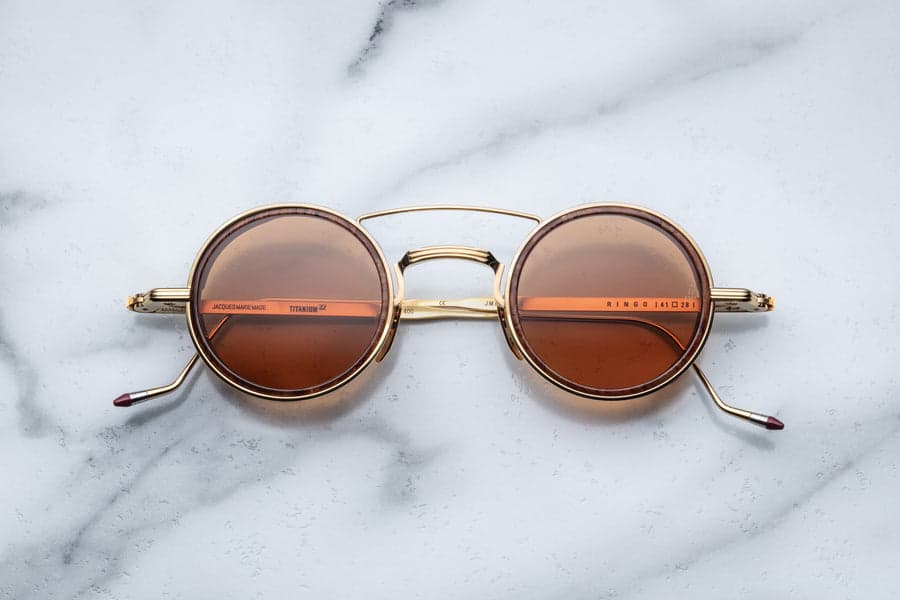
JMM doesn't do obviously round — they do shapes that read round from straight-on but have subtle design detail on closer inspection. The Fellini is the closest to a true round in the JMM catalog: refined, slightly oval-biased, Japanese acetate in 6-8mm thickness.
The Zephirin is a smaller, more restrained round that suits more classical styling. Both start at $985 retail in optical (Zephirin sun from $905). Both are produced in the limited runs typical of JMM — once a colorway is gone, it's gone. Our full JMM spotlight has more detail.
3. Lunor — German precision rounds
Lunor is the German independent brand that takes round frames seriously. Lunor typically runs about $600 to $1,000 at US retailers. Materials include gold-filled metal, titanium, and acetate. The roundness is restrained — Lunor bias toward subtle oval rather than true circle, which reads as classically European.
Lunor's M Series and A Series include some of the best contemporary titanium rounds in the market. If you want round frames that read as "quiet European heritage" rather than vintage Americana, Lunor is the answer.
4. Oliver Goldsmith — British heritage acetate rounds
Oliver Goldsmith has been making eyewear in London since 1926. Their round frames read as British — slightly ironic, slightly intellectual, always restrained. The Pierre, Winston, and Bobby models are modern classics. Retail is about $560 at U.S. retailers.
Oliver Goldsmith rounds work especially well on male professional faces that want round frames without the folk-singer reference. The colorways lean traditional (tortoise, black, horn, honey) but the shapes are refined enough to transcend pure vintage reference.
5. Garrett Leight — California refinement
Garrett Leight is the second-generation Leight (Larry Leight co-founded Oliver Peoples; Garrett is the son). The brand's California aesthetic translates into round frames that feel Pacific-coast rather than European — warmer, less formal, more casual-luxury.
The Hampton and Wilson models are round-adjacent shapes that work daily. Garrett Leight starts at $395 optical and about $425 sun; the Hampton is $395 optical, $455 sun. Acetate construction, good finishing, moderate weight (22-28g typical).
6. MOSCOT — NYC heritage rounds
MOSCOT has been in New York since 1899. Their round frames reference the Lower East Side immigrant-era optical shops, which gives the brand a specific cultural texture. The Lemtosh and Zolman models are the cultural references, both in traditional round and keyhole-bridge variations.
Lemtosh starts at $340; most MOSCOT optical frames are $340-$360. More affordable than most of this list. The fit is deliberately classical — smaller bridges, narrower temple spreads. Best for narrower faces with traditional proportions.
The comparison table
| Brand | Best model | Material | Retail | Best for |
|---|---|---|---|---|
| Lindberg | Strip 9000 | Titanium rimless | $650-$800 | Professional minimalism, daily comfort |
| JMM | Fellini | Japanese acetate | $985-$1,080 | Cinematic expression, collector value |
| Lunor | M Series | Titanium, gold | About $745-$1,000 | Quiet European heritage |
| Oliver Goldsmith | Winston | Acetate | $560 | British intellectual aesthetic |
| Garrett Leight | Hampton | Acetate | $395 optical, $455-$485 sun | California casual refinement |
| MOSCOT | Lemtosh | Acetate | $340 optical, $370-$420 sun | NYC heritage, smaller faces |
The fitting process — where to try them
Round frames need real fitting. The shape amplifies any mismatch between frame and face — a slightly wrong bridge on a round frame looks worse than a slightly wrong bridge on a square frame. A good boutique optician will try at least three round options in different sizes before narrowing.
A few boutiques we'd recommend for round-frame selection:
- Gazal Eyecare in Roswell, Georgia — JMM, Lindberg, and rotating independent rounds.
- Blinka Optical in Geneva, Illinois — deep Lunor and Lindberg round selection.
- L'Optique in Asheville, North Carolina — broader European round options including Anne et Valentin rounds.
- Specs Around Town in Bloomington, Illinois — Lindberg focus; strong for titanium rimless rounds.
Use the practice locator to find more, filtering by your preferred brand.
The bottom line
Round frames are the most subtly dangerous shape to buy online or from a chain store, because small proportion mistakes become glaring on round shapes. A well-chosen round frame at $400-$1,000 from a boutique will look better and wear better than any $150 round frame you can find quickly.
Start with 48-52mm. Start with a material you already know works for your face. Try both titanium (quieter, more architectural) and acetate (warmer, more expressive). Don't buy the first round you like — buy the third, after you've calibrated your sense of what the shape can look like across different brands.
And if your face is round-shaped, skip this list and browse our best-for-round-faces guide — square and rectangle frames almost certainly suit you better.
Frequently Asked Questions
Do round frames look good on round faces?
Generally no. Round frames on round faces amplify softness and can read as infantilizing. The classical face-shape rule holds: round faces benefit from angular frames (square, rectangle, modified cat-eye). Round frames work best on square, rectangular, diamond, and heart-shaped faces.
What size round frame should I buy?
Depends on the look. 44-48mm reads vintage/Lennon. 50-52mm reads contemporary/fashion. 52-54mm reads contemporary/statement. Larger round frames (56mm+) are cinematic — harder to pull off but striking on the right face.
Are round frames a passing trend?
Round frames predate modern eyewear trends by a century — every major eyewear era has produced round shapes. The specific proportions shift (smaller vintage in the 2010s, larger contemporary in the 2020s), but the basic shape is perennial. Buying a well-made round frame today will still look right in 2035.
Which material works best for round frames?
Both titanium and acetate round frames are viable; the choice depends on the desired aesthetic. Titanium rounds (Lindberg, Lunor) read as architectural and professional. Acetate rounds (JMM Fellini, Oliver Goldsmith) read as warmer and more expressive. Try both if the brand offers them in similar shapes.
Is there such a thing as 'too round'?
Yes. Perfectly circular frames (true circles, no subtle oval) can read as costume or retro-ironic. The best contemporary rounds are subtly oval-biased — slightly wider than tall, which flatters more face shapes and avoids the 'cartoon spectacles' look. Lindberg and Lunor both bias this way intentionally.
Are round frames good for office wear?
Yes, with restraint on size. A 48-50mm titanium round (Lindberg, Lunor) is appropriately conservative for any office. A 54mm acetate round in a bold colorway (JMM, Anne et Valentin) is more expressive but still office-appropriate in most creative and professional environments.
Newsletter
Independent eyewear, in your inbox
Monthly stories on the world's finest independent eyewear brands and boutiques.
Related Reading
Best Square Frames for Round Faces: 5 Picks That Work
Angular frames balance a round face. Five picks from Lindberg, Jacques Marie Mage and Anne et Valentin, plus the proportion rule most guides skip.
Best Designer Glasses for Wide Faces: Brands That Fit Without Pinching
Designer glasses for wide faces: Akoni's wider-running titanium, Gazal Eyewear's 19-20mm wide bridge, Lindberg made-to-order sizing, and which brands run narrow.
How to Measure Your Face Shape at Home — A 5-Minute Method
A simple, accurate way to identify your face shape using a mirror and a tape measure — no app or guesswork required.
Comments
0 comments · moderated
No comments yet. Be the first to weigh in.