I spend more time talking patients out of the wrong lens tint than into it. A customer will walk in having decided they want "blue polarized lenses because they look cool." Blue distorts red and green perception. Driving becomes borderline dangerous. The sunglass gets retired to a drawer within three months. Tint choice is where a lot of sunglass purchases quietly go wrong.
This guide is a practical framework for fitting lenses to frames. The short version: tint color and density should be chosen based on your visual needs first, your frame aesthetic second, and your "I saw this look on Instagram" instinct last. The long version is below.
Quick Answer — the decision framework
For most wearers buying their first real sunglass, the decision tree is simple:
- Primary driving or bright-sun use? → Grey solid at 15-20% VLT, polarized if budget allows.
- Variable light (outdoor work, hiking, golf)? → Brown at 15-20% VLT, polarized.
- Style-first wear with mixed lighting? → Gradient grey, green, or rose at 25-35% VLT.
- Indoor-outdoor transitional wear? → Gradient tint at 35-50% VLT, or photochromic.
- Water, snow, or high-glare environments? → Polarized brown or grey at 15% VLT, plus side shielding if serious.
That covers most wearers. The rest of this guide is the detail — how specific tint colors and densities pair with specific frame styles, materials, and brands.
The four tint-color families
Grey — the neutral workhorse
Grey tint preserves color perception accurately. A red stoplight looks red. A green traffic signal looks green. Skin tones appear natural. The only thing a grey lens does is reduce brightness.
Grey is the default for driving, professional wear, and anyone who needs accurate color perception through the lens. It's also the safest pick aesthetically — grey works with any frame color, any face shape, any skin tone.
The downside: grey can feel flat. It doesn't enhance anything, it just dims the world. For wearers who want something more expressive, brown is usually the step up.
Brown (and amber) — enhanced contrast
Brown tint enhances contrast by selectively darkening blue and purple wavelengths. Trees, sky, grass, and road surfaces become more visually distinct. This is why most fishing guides wear brown-tinted polarized — the fish become easier to see against the water.
Brown warms skin tones (both yours through the lens and yours viewed by others through the lens). It flatters warm-tone faces. It can slightly dull cool-tone faces, so consider rose or green-grey if you're clearly cool-tone.
Brown is the best generalist tint. If you had to pick one lens color for everything except bright mid-day driving, brown is the answer.
Green — true-color with warmth
Green tint is the traditional sunglass color — think Ray-Ban G-15 glass lenses. It reduces brightness while preserving most color perception, with a slight warm bias that flatters most skin tones.
Green works especially well with titanium frames (Lindberg, Akoni) and traditional round or aviator shapes. It reads as classic. It ages well — a green-tinted aviator in 2040 will look essentially the same as it did in 1960.
For wearers who want a more characterful alternative to grey, green is the answer. It's also the most forgiving gradient tint — green-to-clear gradients look sophisticated on almost any frame.
Rose, blue, yellow, and specialty tints
These are style-first tints with specific use cases:
- Rose/pink: sharper contrast in variable light, flatters cool-tone skin, works with bold acetate frames. Avoid for driving.
- Blue: distorts red-green perception. Never for driving. Works as a pure fashion statement with certain bold frames — but consult a boutique optician first.
- Yellow: enhances contrast in low light (cloudy days, overcast, early evening). Not a sunglass tint per se — more of a driving or sport-specific tint. Night-driving yellow tints are controversial; the science is mixed.
- Mirror finishes (silver, gold, blue): cosmetic surface treatment that sits on top of a base tint. Reduces visible eye contact (the wearer's eyes are harder to see from outside). Can look great on the right frame, gimmicky on the wrong one.
The VLT density guide
VLT (visible light transmission) is the percentage of light the lens lets through. Lower number = darker lens.
| VLT | Use case |
|---|---|
| 15-18% | Bright sun, high glare (water, snow, mid-day driving) |
| 18-25% | Standard sunglass — all-day outdoor wear |
| 25-35% | Lighter sunglass, variable conditions, fashion |
| 35-50% | Very light sunglass, indoor-outdoor transitions |
| 50-85% | Tinted optical lens (not a true sunglass) |
Most wearers over-estimate how dark they need. Buying a 15% VLT lens for everyday city wear often means you squint indoors (at restaurants, parking garages, offices). A 25% VLT in a neutral color is more versatile for daily wear than a very dark 15% VLT.
Exception: if your environment is consistently bright (beach, water, high elevation, open driving), go darker.
Pairing tint to frame style — specific brand examples
Titanium minimalist frames (Lindberg, Akoni, Lunor)
The frame disappears by design, so the lens tint becomes more visually prominent. Keep it quiet.
- Best pairings: grey solid, green solid, green gradient, very subtle brown gradient
- Avoid: bold tints, mirror finishes (they overpower the frame's understatement)
- VLT: 18-25% solid for daily wear
- Reasoning: Lindberg and Akoni are architectural. The lens should complete the architectural feeling rather than competing with it.
Thick acetate frames (Jacques Marie Mage, Anne et Valentin, Oliver Peoples)
The frame has visual presence, which means the lens can be bolder without creating imbalance.
- Best pairings: brown solid, rose gradient, green gradient, smoked grey gradient
- Can handle: mirror finishes on larger statement frames, color tints like amber or rose
- VLT: 18-28% for solid, 25-40% for gradients
- Reasoning: JMM and Anne et Valentin design for visual impact. The lens can extend that impact rather than muting it.
Sterling silver or precious metal frames (Chrome Hearts, Cartier gold lines, Lindberg Precious)
The metal hardware is the visual story. The lens should let it remain so.
- Best pairings: grey gradient (preserves hardware visibility), brown solid, very subtle amber
- Avoid: bright or mirrored tints that compete with the metal detailing
- VLT: 20-30% gradient, 18-22% solid
- Reasoning: Chrome Hearts and Cartier are jewelry-adjacent. The silver or gold work is the point. A bold lens color pulls attention away from the detailing.
Round frames (Lindberg Strip, JMM Fellini, Lunor rounds)
Round frames flatter with softness. The tint should extend that sensibility.
- Best pairings: green solid, brown solid, subtle rose gradient
- Avoid: harsh mirror finishes, very dark neutral greys that make the round shape look severe
- VLT: 20-28% solid
- Reasoning: Round frames have a classical, almost literary quality. Tints with a slight warmth (green, brown, subtle rose) reinforce that feeling.
Square and geometric frames (JMM Torino, Anne et Valentin Brooklyn, Akoni Zenith)
Angular frames have architectural rigor. Tints can either reinforce the angularity (dark neutral) or soften it (warm gradient).
- Best pairings for rigor: grey solid, brown solid, both at 18-22% VLT
- Best pairings for softening: brown gradient, green gradient at 25-35% VLT
- Reasoning: Square frames can read austere. Gradient tints add warmth that balances the geometric rigidity.
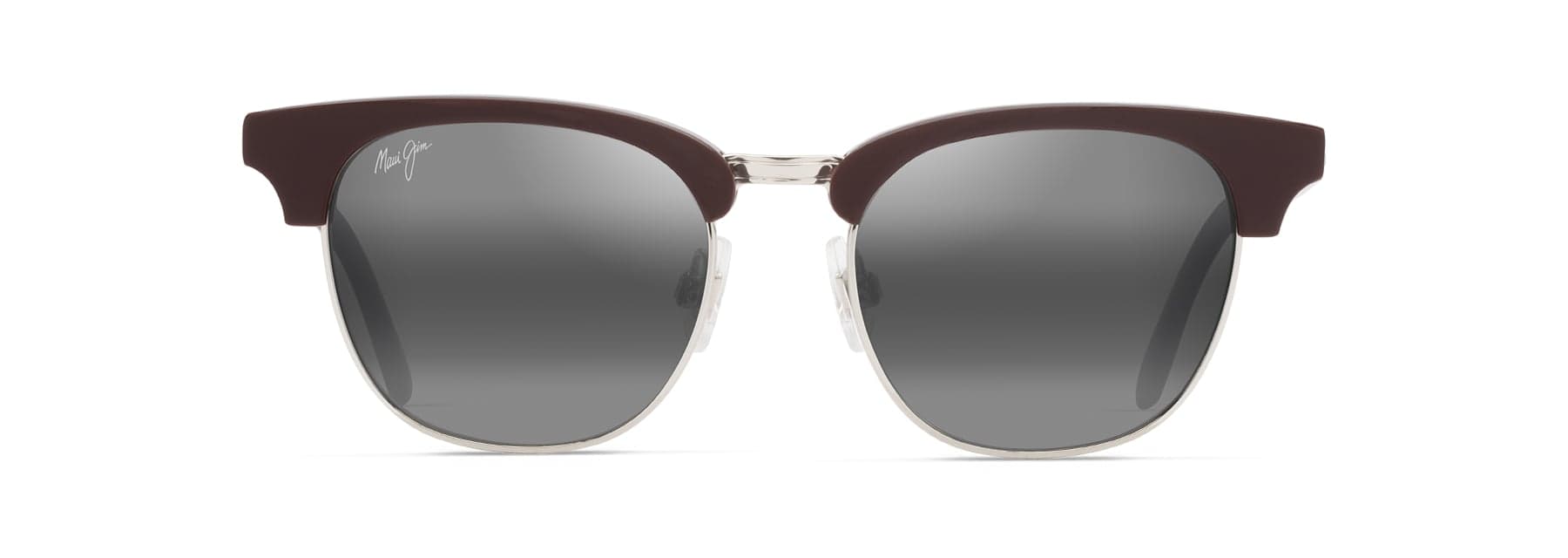
Aviators (Maui Jim, Ray-Ban Aviator, Randolph Engineering)
Aviators are a specific cultural reference. Tints should respect that reference.
- Best pairings: green solid (the G-15 classical reference), brown solid, grey solid
- Can work: subtle mirrored (silver or gold) over a base green or brown
- Avoid: bold colors (rose, blue) — they fight the aviator's classical character
- VLT: 15-20% for aviators — they're designed as true sunglasses
- Reasoning: Aviators reference military and aviation heritage. Classical tints reinforce the reference; bold tints undermine it. Our Maui Jim spotlight covers polarized aviator specifics.
The polarization question
Polarized lenses block glare from horizontal surfaces (water, roads, car hoods, snow). They come in any tint color — grey polarized, brown polarized, green polarized are all standard.
Who should go polarized:
- Anyone who drives more than 30 minutes daily
- Anyone on the water (fishing, boating, surfing)
- Skiers, mountain users, golfers
- Construction, landscaping, outdoor professionals
- Anyone with light-sensitive eyes
Who might skip polarization:
- LCD screen users (some phone and car display screens look strange through polarized)
- Pilots (cockpit displays can interact oddly with polarization)
- Wearers who prioritize lightness in daily wear (non-polarized lenses are typically slightly thinner and lighter)
Polarization adds $100-$200 to the lens cost. For most wearers, it's worth it — the glare reduction is substantial. Our Maui Jim spotlight covers the polarized category.
Gradient versus solid — when each works
Solid tint: same density across the full lens. Better glare protection at the lens bottom. Best for pure sun use. Looks more traditional.
Gradient tint: darker at the top, progressively lighter toward the bottom. Worse glare protection at the bottom. Better for indoor-outdoor transitions and for seeing phone screens or keyboards without removing the sunglasses. Looks more contemporary.
For a first sunglass, solid tint is usually the right choice. For a second pair (fashion-forward, city wear, transitional use), gradient can be excellent.
Where to actually fit tinted lenses
Tinted sunglasses — and especially tinted prescription sunglasses — benefit from boutique fitting more than clear optical. The tint choice requires in-person comparison: holding the tinted lens up to natural light, comparing multiple tints on the same frame, and testing for glare reduction in situ.
Boutiques to consider for tinted lens fittings:
- Gazal Eyecare in Roswell, Georgia — custom lens tinting with Zeiss and Essilor partnership.
- Blinka Optical in Geneva, Illinois — strong custom-tint capability with JMM and Lindberg sunglass work.
- L'Optique in Asheville, North Carolina — broader European brand sun selection.
- Bixby Eye Center in Peoria, Illinois — Akoni and Maui Jim sun specialties.
Or use the boutique practice locator to find one near you.
The bottom line
Lens tint is more decision than most buyers give it credit for. The right tint color and density for your frame, your face, and your daily environment will dramatically outperform the wrong tint at the same price. A $400 solid grey polarized lens in the right density beats a $600 mirrored amber gradient in the wrong one.
Start with the decision tree at the top of this guide. Cross-reference to your specific frame — minimalist titanium, bold acetate, silver-detailed, round, square, aviator. Try multiple tints on the same frame in a boutique. Don't buy the first tint you like — buy the third, after you've calibrated your sense of how tint and frame work together.
And if you wear prescription sunglasses, spend the extra on proper boutique-level lens tinting. The lens is where your eyes are. The frame is just the delivery vehicle. Find a boutique that takes lens selection as seriously as frame selection.
Frequently Asked Questions
What tint color is best for driving?
Grey or brown at 15-20% VLT (fairly dark). Grey preserves accurate color perception, which matters for traffic signals. Brown enhances contrast in variable light (cloudy/sunny alternating). Avoid blue, yellow, or rose tints for primary driving wear — they distort traffic-signal colors.
Does tint color affect my face's appearance through the lens?
Yes, subtly. Brown and rose tints warm your skin tone when people look at your face through the lens. Grey and green keep your skin tone neutral. Blue and green cast a cooler cast. Most wearers don't think about this because lens tint is typically chosen for the wearer's view out, not for how others see them — but it does register.
What's VLT and why does it matter?
VLT is visible light transmission — the percentage of visible light the lens allows through. 85% VLT is a very light tint (indoor use). 15% VLT is a dark sunglass tint. Most daily sunglass tints run 15-25% VLT. Fashion-forward lighter tints run 40-70% VLT. Polarized lenses typically run 15-20% VLT regardless of tint color.
Should the tint match my frame color?
Usually no. Match by complementing, not mirroring. A black acetate frame with a brown tint reads richer than black-on-black. A tortoise frame with a green-grey tint reads more interesting than tortoise-on-amber. The frame and lens should work as a composition, not a single color block.
Are gradient tints less effective than solid tints?
They offer less glare protection at the lens bottom where the tint fades. For primary sun wear, solid tints at the correct VLT outperform gradients. Gradients are better for indoor-outdoor transitional wear (restaurants, driving with frequent stops) where you want the lens to be lighter at the bottom. For pure sunglass use, go solid.
What tint works with Chrome Hearts or heavy silver-detail frames?
The silver hardware is visually dominant, so the lens should balance rather than compete. Grey gradient (darker at top, lighter at bottom) lets the silver detailing remain the focal point. Brown is the second-best choice. Avoid bold or colorful tints (rose, blue, amber) — they fight the silver for attention.
Newsletter
Independent eyewear, in your inbox
Monthly stories on the world's finest independent eyewear brands and boutiques.
Related Reading
Flash Mirror vs Solid Mirror Sunglass Lenses — Which Reflectance Level Suits Your Life
Flash mirrors reflect a small share of light with eyes partially visible; solid (full) mirrors reflect much more and hide the eyes. Choosing between them comes down to activity, setting, and how much eye privacy you want.
Best Luxury Sunglasses Brands of 2026: Lens-First Picks
The best luxury sunglasses brands for 2026, chosen lens first: Maui Jim for polarized glare control, Jacques Marie Mage and Akoni for frames, plus tint and VLT basics.
Mirror Flash Coatings: Colors, Durability & Face Flattery
Mirror coatings (silver, gold, blue, green, rose) reflect part of the incoming light and last 2–3 years. Which flash color flatters your skin tone and frame.
Comments
0 comments · moderated
No comments yet. Be the first to weigh in.