
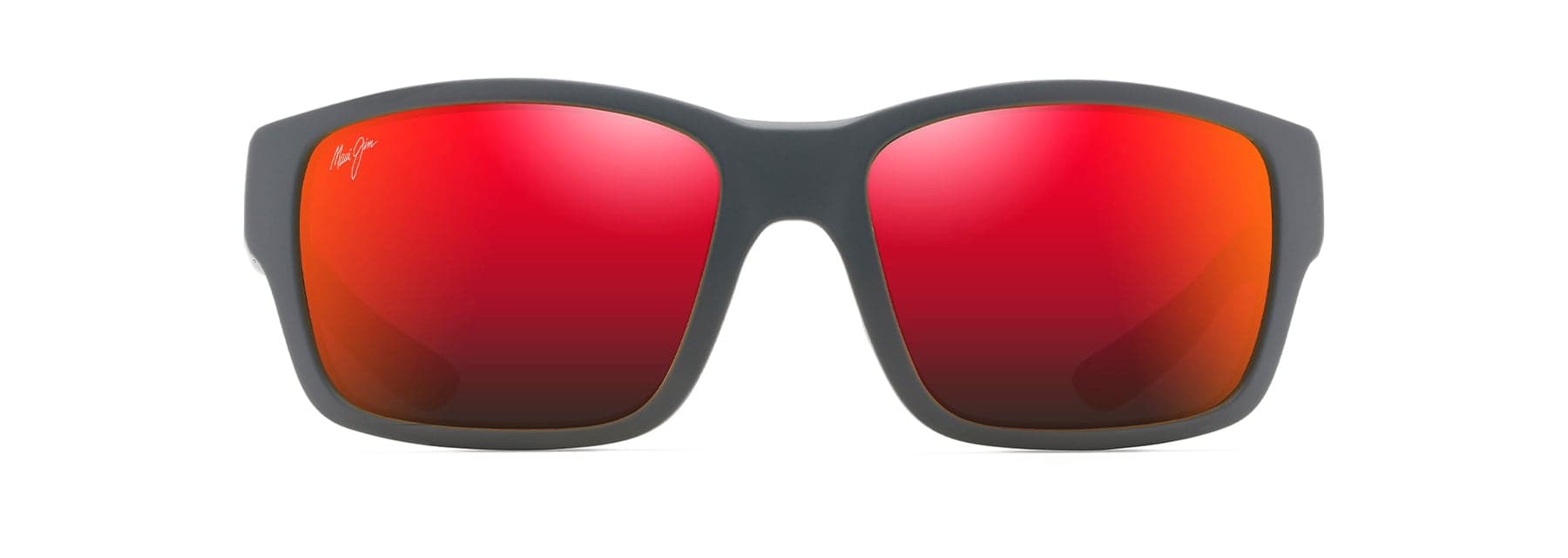
The first pair of Maui Jims I ever sold was to a fishing guide from Jacksonville who had worn the same brand for twenty-plus years. He told me he'd tried every premium polarized on the market — Costa, Smith Optics, Oakley Prizm, Revo — and kept coming back to Maui Jim because the fish were easier to see. That's not a marketing line. That's a repeat customer summing up forty years of lens technology in one sentence.
Maui Jim is the sunglass brand that most casual buyers don't understand, because the story isn't the frame. It's the lens. Every competing premium polarized brand eventually gets compared to Maui Jim, and most fall short in specific categories where the brand's R&D has quietly dominated for decades.
Quick Answer — what Maui Jim is
Maui Jim is an American polarized sunglass brand tracing to Lahaina Beach, Maui, in 1980. The brand's proprietary PolarizedPlus2 lens technology combines three-layer polarization, chroma-boost coatings, and full UV/HEV filtering. Retail runs roughly $199-$450 for standard sunglasses. Distribution is boutique opticals, select premium sporting-goods retailers, and direct. Acquired in 2022, it is now part of Kering Eyewear.
The origin — a roadside stand on Lahaina
The "Maui Jim" name traces back to a fisherman, Jim Richards, selling polarized sunglasses from a stand on Ka'anapali beach in Lahaina starting in 1980 — polarized lenses fitted to imported frames, priced for vacation shoppers who needed glare protection for the Hawaiian sun. In 1991, Walter Hester bought the company and built it into the brand it is today; Maui Jim's own site dates the modern company to 1987.
The turning point came when Hester and his team started investing seriously in lens R&D at their Peoria, Illinois facility. The first PolarizedPlus technology debuted in the late 1980s. PolarizedPlus2 — the current-generation lens — launched in the early 2000s and has been refined continuously since.
Today Maui Jim is a well-known American polarized-sunglass brand, part of Kering Eyewear since 2022. In my view, from the wearer's perspective, the product still feels much as it did before the acquisition.
PolarizedPlus2 — what the lens actually does
This is the reason the brand exists. PolarizedPlus2 is a multi-layer lens construction that addresses three problems ordinary polarized sunglasses don't solve:
-
99.9% glare rejection. Three layers of polarizing film, oriented precisely to block reflected light off horizontal surfaces (water, asphalt, car hoods, snow). Most polarized sunglasses use one polarizing layer; Maui Jim uses three.
-
Chroma-boost coatings. Two additional coatings that selectively enhance the color differentiation of the visible spectrum. Greens look greener. Reds look more saturated. The result is better visual contrast under mixed light — which is why fishing guides specifically choose the brand. Seeing fish through water requires color differentiation, not just polarization.
-
UV and high-energy visible (HEV) blue light filtering. Maui Jim states its lenses block 100% of UV and manage about 95% of high-energy visible (blue) light, per the brand's own specs. Most polarized sunglasses meet ANSI standards for UV but ignore HEV. The clinical benefit of blue-light filtering is still debated.
The combination of these three is what separates Maui Jim from cheaper polarized options. Under controlled side-by-side testing, the difference is obvious. Under casual comparison at a store, not always — which is why the brand sells best to wearers who've tried other polarized options and are looking for specifically better performance.
Lens material choices
Maui Jim offers three lens materials:
- MauiPure (polycarbonate) — light, impact-resistant, excellent optics. The default choice for most wearers. Slightly less optically perfect than glass at the edges but significantly more durable.
- MauiPure Glass — heavier but the clearest optical performance. For fishing guides, pilots, and professionals who care about edge-to-edge clarity above weight savings.
- SuperThin Glass — thinner glass formulation, reduced weight vs standard glass while keeping optical clarity.
For a first pair, most boutique opticians recommend MauiPure polycarbonate unless the wearer has a specific reason to go glass. It's more versatile, more durable, and the optical difference is subtle.
The frames — serviceable but not the story
Maui Jim frames are produced in various Asian workshops to Maui Jim specifications. Materials are nylon (Grilamid — a German polymer that's lightweight and stable) or titanium for the higher-end lines. Build quality is fine. Hinges are proprietary and adjustable. Finishes are durable.
But the frames aren't where the brand's IP lives. A Maui Jim frame is essentially a delivery vehicle for the lens. Compared to Jacques Marie Mage or Chrome Hearts as frame design objects, Maui Jim is modest. That's by design — the brand sells performance, not statement. If you want the frame to be the story, Maui Jim isn't your answer.
Signature models:
- Peahi — the iconic Maui Jim wraparound. Excellent for water sports and driving.
- Kanaio — classic aviator silhouette. The all-purpose Maui Jim.
- Stingray — smaller aviator variant, fits narrower faces.
- Ailana — sleeker modern sun, more fashion-adjacent.
- Laulima — women's-leaning shape, refined aviator.
- Makaha — angular square sun, more contemporary styling.
Who should buy Maui Jim
A specific list:
- Anyone on the water regularly (fishing, boating, surfing) — the chroma boost is genuinely useful
- Long-distance drivers — the glare rejection matters on sustained daytime driving
- Pilots — for the same reason, plus the UV/HEV filtering
- Skiers and mountain users — high UV environments reward Maui Jim's filtering spec
- Outdoor workers (construction, landscaping, agriculture) — durability plus performance
- Anyone with light-sensitive eyes (post-cataract, chronic photophobia, light-colored irises)
Who probably doesn't need Maui Jim:
- Casual urban sun wearers who want a style piece — consider JMM, Akoni, or Persol
- Collectors — Maui Jim has no collector market; resale is unusual
- Anyone prioritizing frame design over lens performance — the brand isn't about the frame
Where to buy
Maui Jim is available at more retailers than most brands in our coverage — it's distributed through boutique opticals, premium sporting-goods stores, and direct online. For a first Maui Jim, boutique opticals are still the best path because the fitting matters and because lens choice (MauiPure vs glass) benefits from expert guidance.
A few of our boutiques that carry Maui Jim:
- Gazal Eyecare in Roswell, Georgia — Atlanta-area; Maui Jim available with prescription.
- Blinka Optical in Geneva, Illinois — Chicago-area dealer.
- Bixby Eye Center in Peoria, Illinois — worth noting, because Peoria is home to Maui Jim's US R&D and manufacturing center.
- L'Optique in Asheville, North Carolina — broader sun selection including Maui Jim.
Find other authorized dealers via the practice locator.
The bottom line
Maui Jim is worth the premium if you spend real time outdoors. The PolarizedPlus2 lens genuinely outperforms cheaper polarized alternatives in measurable ways, and the brand has forty years of lens R&D behind it. For fishing, driving, water sports, or outdoor work, it's the sunglass I'd recommend over Costa, Smith, Oakley, or any fashion-luxury brand that happens to sell polarized sunglasses.
If you want eyewear as style expression, look elsewhere — Jacques Marie Mage, Akoni, Persol, or traditional luxury sun brands. If you want eyewear as performance tool, Maui Jim is the answer. The frame is fine. The lens is the reason.
And fit the frame in a boutique. Even the best lens technology doesn't perform if the frame doesn't sit right — and a 10-minute chain-store fit is the fastest way to undermine a premium sunglass purchase. Find a boutique that stocks Maui Jim and can walk you through the MauiPure vs glass decision in person.
Frequently Asked Questions
Are Maui Jim lenses really better than other polarized sunglasses?
Yes, measurably. PolarizedPlus2 does three things most polarized lenses don't — 99.9% glare rejection, chroma-boost coatings that enhance color differentiation, and UV/HEV filtering that surpasses ANSI standards. Independent reviews consistently rank Maui Jim lenses at the top of the polarized sunglass category.
Is Maui Jim still made in Hawaii?
No, and they never were fully. The brand started in Hawaii, but lens R&D and production is based in Peoria, Illinois, where Walter Hester — who bought the company in 1991 and built it into the brand it is today — established the company's manufacturing operations. Frames are produced in various Asian workshops with Maui Jim-controlled specs.
Did the Kering acquisition change Maui Jim?
Kering Eyewear acquired Maui Jim in 2022, which means it is no longer an independent company. We have not independently confirmed what has or has not changed in its lens manufacturing or distribution since then, so ask your optician about the current lens specs for the exact model you are considering.
What's the difference between Maui Jim glass and polycarbonate lenses?
Glass lenses (MauiPure or SuperThin glass) have the clearest optics but are heavier and break on impact. Polycarbonate (MauiPure polycarbonate) is lighter, impact-resistant, but slightly less optically perfect. For fishing, driving, or general wear: polycarbonate. For critical-clarity activities like photography or flying: glass.
Is Maui Jim worth the price vs cheaper polarized sunglasses?
If you spend serious time outdoors with glare exposure, yes. The color rendering and glare rejection on PolarizedPlus2 is noticeably better than sub-$150 polarized sunglasses from any brand. For casual sun wear, the premium may be hard to justify — but for fishing, driving long distances, water sports, or extended outdoor work, it pays back.
Can I get prescription Maui Jim?
Yes, through authorized boutique opticals. Rx Maui Jim uses the same PolarizedPlus2 lens technology in prescription form, cut for your specific Rx. Lead time is typically 2-3 weeks. Rx adds cost depending on the frame, lens and prescription complexity; ask your optician for a quote.
Newsletter
Independent eyewear, in your inbox
Monthly stories on the world's finest independent eyewear brands and boutiques.
Related Reading
Best Luxury Sunglasses Brands of 2026: Lens-First Picks
The best luxury sunglasses brands for 2026, chosen lens first: Maui Jim for polarized glare control, Jacques Marie Mage and Akoni for frames, plus tint and VLT basics.
CAZAL Spotlight - German Boldness, Gold-Tone Hardware, and Hip-Hop History
CAZAL was founded in Germany in 1975 by Cari Zalloni and Günter Böttcher. The bold acetate and metal frames became a defining accessory of 1980s hip-hop style, especially through the 607 worn by Darryl "DMC" McDaniels.
Robert Marc Spotlight - The New York Boutique Behind a Designer Eyewear Collection
Robert Marc opened its first optical boutique on Manhattan's Columbus Avenue in 1981 and launched its own acetate and titanium collection in 1999. Core frames retail about $495-$795.
Comments
0 comments · moderated
No comments yet. Be the first to weigh in.