A common question is whether a $1,400 frame is worth it over a $350 frame. The price gap suggests the $1,400 frame is four times better. It isn't — and a well-chosen frame around $500 can do most of what the $1,400 frame does, at a fraction of the spend.
This guide is me being honest about where the money goes when you move up the eyewear price ladder. I've sold every tier from $150 chain frames to $3,200 Chrome Hearts, and the quality jumps aren't evenly distributed. Knowing where the real steps are is how you avoid overpaying.
Quick Answer — where the meaningful steps happen
The biggest quality jump in eyewear is between roughly $250 and $500. Below that, you're mostly buying Chinese-factory output rebadged for retail. Above $500, you're paying for material authenticity, craftsmanship, and brand provenance — and the returns flatten fast after about $1,200 unless you specifically need what's at the top of the ladder.
If I could only give one piece of advice: pick the right $600-$750 frame and put more of your budget into lenses. That beats a $1,500 frame with mediocre lenses every single time. Your eyes are behind the lenses, not in front of the frame.
What you're actually paying for at each tier
Here's the honest breakdown.
The $150-$300 tier
Most of what's sold here is Chinese-factory acetate or stainless steel, rebadged by a mainstream "designer" license (Versace, Michael Kors, Coach, Burberry eyewear). The acetate is bulk-cut, the hinges are generic, and the hand-finishing is minimal — if any. This isn't a knock on the segment; plenty of wearers are perfectly served here, especially for backup pairs.
The failure mode: acetate that yellows or cracks in 3-4 years, hinges that loosen and can't be repaired, nose pads that shed. The coatings on the lenses (if they come with lenses) are usually where chain opticals recoup margin.
The $300-$500 tier — the first meaningful step
This is where honest materials start appearing. Premium Italian acetate. Japanese or European titanium. Independently-owned brands that design in-house.
Brands in this tier: Andy Wolf (Austria), Res/Rei (Italy), Krewe (New Orleans), Garrett Leight (California), older Salt Optics.
You're getting real acetate or real titanium, in-house design, and genuine independent ownership. The frame will hold up for 8-12 years. This is where most wearers who care about eyewear should start.
The $500-$900 tier — luxury materials at honest prices
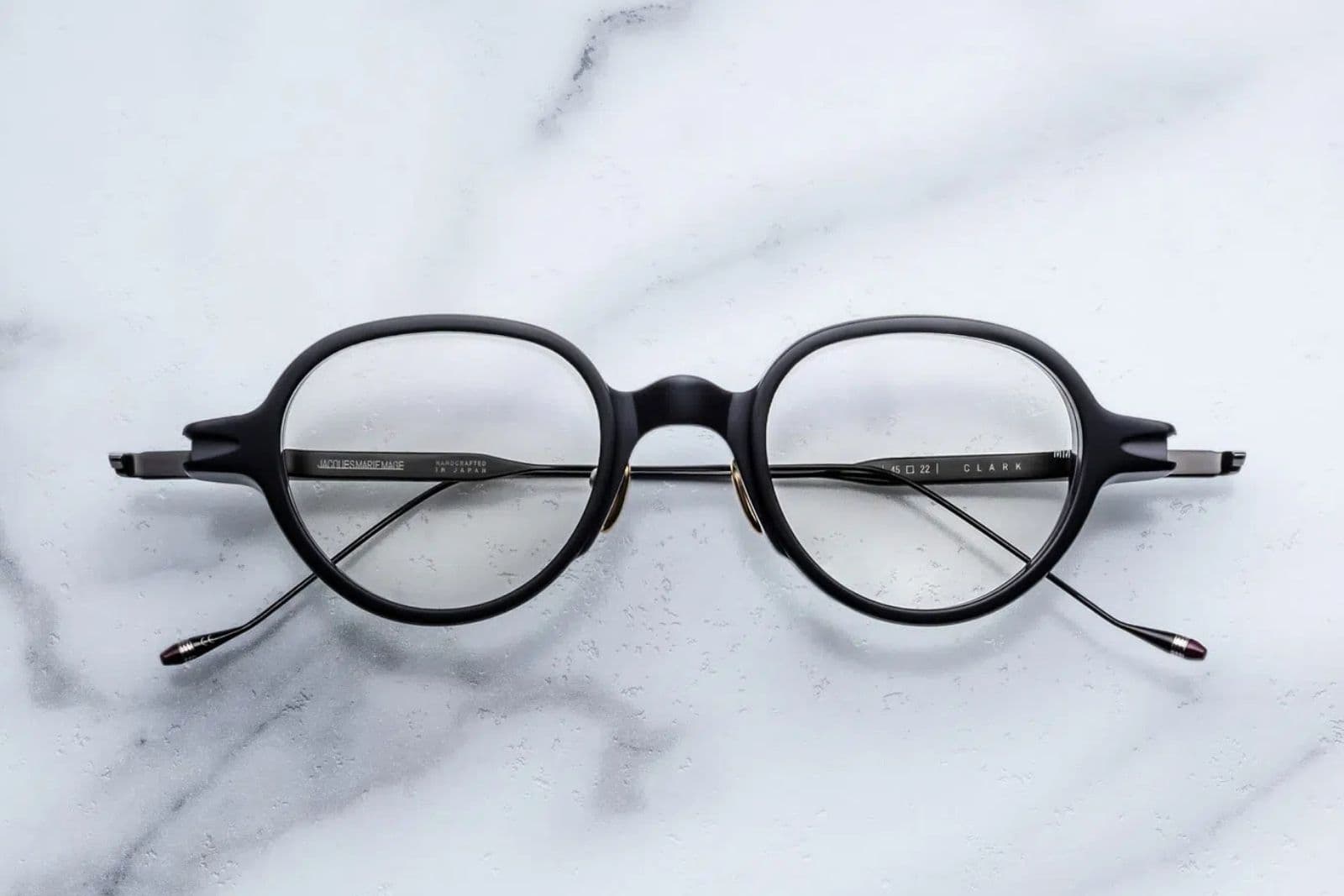
This is the sweet spot. You're buying from brands that own their materials, control their production, and refuse to cut corners. Gazal Eyewear runs $400-$1,200 and lands mostly here — the material match to brands at nearly twice the cost is striking for the price. Akoni at $575-$1,190+. Anne et Valentin at roughly $385-$715. Lindberg's standard titanium Air, Spirit, Strip and N.O.W. builds at roughly $650-$850. Jacques Marie Mage sits just above this tier, with optical frames starting at $985.
The difference from the prior tier is mostly finishing time and sizing range. At this level, frames are hand-polished longer, hinges are often proprietary (Lindberg's screwless, JMM's rivet-hinge, Akoni's recessed pivots), and fit ranges are broader — boutiques carry multiple bridge and temple lengths.
For a first luxury purchase, this is my default recommendation. You'll feel the material jump. The frame will last a decade.
The $900-$1,500 tier — rarity and serious engineering
Here you're paying for one of three things: rarity (small-batch production), engineering (sub-3g titanium construction, which Lindberg's Air Titanium Rim delivers for less, at roughly $650-$850), or brand signature (DITA Mach series, JMM Dealan/Molino signatures).
A Lindberg Air Titanium Rim weighs 2-3g. That's not a marketing claim — I've weighed them on a jewelry scale. The engineering is real. Some discontinued JMM colorways resell above retail. The rarity is real.
What you're not paying for anymore: dramatically better raw acetate. Quality Italian acetate is quality Italian acetate across most independent brands at this level. The jump is in the finishing hours and the production scarcity.
The $1,500-$3,000+ tier — true luxury, questionable returns
This is where Chrome Hearts, Cartier, some Jacques Marie Mage limited editions, Lindberg's buffalo-horn models (from about $2,400), and some Rigards horn pieces live. Now you're paying for 18K gold, sterling silver, hand-engraved detailing, or genuinely precious materials.
Chrome Hearts uses real sterling-silver hardware on eyewear primarily produced in Japan. Cartier uses gold-finish metal in the Panthère and Santos lines. Lindberg's buffalo-horn models run roughly $2,360-$2,560.
Honest take: for most wearers, this tier is emotional, not functional. The frame isn't 3x better than the $700 frame. You're buying a piece of jewelry that reads as a status signal, and there's nothing wrong with that — but know what you're actually buying.
The lens question — where most buyers get it wrong
Above a $400 frame, your lens choice matters more than spending more on the frame.
Here's a specific comparison I run for patients:
| Scenario | Frame cost | Lens cost | Total | Real-world performance |
|---|---|---|---|---|
| Aggressive frame spend | $800 Lindberg Air Titanium Rim | $300-$450 entry progressive | $1,100-$1,250 | Limited clarity at peripheral vision, eye strain |
| Balanced spend | $650 Akoni | $450-$650 Shamir Autograph III freeform | $1,100-$1,300 | Sharp across full viewing field, no eye strain |
| Over-lensed | $450 Res/Rei | Around $1,000 complete premium package (Zeiss Precision Pure, high-index, premium AR) | Around $1,450 | Best optical performance of the three |
The over-lensed scenario wins on actual daily performance. The aggressive-frame scenario loses to both — and it costs about the same as the balanced one. That's not an accident — lens technology has improved faster than frame technology over the last decade.
If you wear progressives, plan the lenses first. At independent high-end practices, a complete lens package (premium progressive, high-index material and premium anti-reflective coating) typically runs around $1,000. Only cut back on lenses if you're buying a second or third pair of frames for variety, not primary wear.
Where the diminishing returns set in
The honest ladder of diminishing returns looks like this:
- $150 to $500: massive jump. Real materials appear. Real construction appears.
- $500 to $900: moderate jump. Finishing improves. Brand DNA becomes visible.
- $900 to $1,500: small jump. Mostly rarity or engineering premium.
- $1,500 to $3,000+: minimal functional jump. Emotional or status premium.
Every wearer's correct tier is different. A clinical patient with skin sensitivity might genuinely need titanium, which pulls them into the $500+ tier immediately. A stylist who cares about color and shape might justify $1,000+ for JMM. An office professional with 10-hour days might justify Lindberg at $800-$900 because comfort is performance. A collector might justify Chrome Hearts.
What I push back against: buying $1,500 frames because "luxury is supposed to cost that much." That's not a reason. Luxury is supposed to deliver a reason.
How to make the decision at the boutique
A few specific questions to ask yourself when you're holding a frame you can't decide on:
- Does it feel like 5 grams or 30 grams? Weight is the single biggest predictor of all-day comfort. Test by closing your eyes with it on for a minute.
- Is the bridge right for your nose? Bridge mismatch is the #1 cause of frames that end up in a drawer. If it slides, doesn't matter how expensive it is.
- Do the temples sit naturally on your ears without pressure? A well-fit frame shouldn't leave marks.
- Could you wear this three days in a row without a second thought? If you're worrying about damaging it, you'll under-wear it.
- Would you still want this in five years? Trendy frames at $1,200 age badly. Timeless shapes at $700 age well.
If the answers are yes, the price is the price. If any answer is a real no, step down a tier — or try a different shape.
Where to try multiple tiers in one visit
The best way to calibrate your own sense of value is to try several tiers in the same afternoon. Independent boutique opticals are built for this — they typically stock three to six brands across multiple price tiers:
- Gazal Eyecare in Roswell, Georgia — Gazal at $400-$1,200, Akoni at $575-$1,190+, rotating Kuboraum and JMM.
- Blinka Optical in Geneva, Illinois — curated independent selection spanning $400-$1,500.
- Bixby Eye Center in Peoria, Illinois — central-Illinois boutique with Akoni and Lindberg inventory.
- L'Optique in Asheville, North Carolina — broader European rotation, good for cross-tier comparison.
Or use the practice locator to find an independent optical near you.
The bottom line
$500+ eyewear is worth it — with conditions. The conditions are: you fit the frame properly, you pair it with the right lenses, and you know what the premium is actually buying you at each tier. A thoughtfully chosen $650 frame with premium lenses beats a $1,400 frame with basic lenses, every time.
Start in the $500-$900 range for your first real pair. Put serious budget into the lenses. If you love the frame after a year, graduate to $1,000+ for your next one. If you realize you want something louder or rarer, that's when Jacques Marie Mage or Chrome Hearts earns their price.
Not sure where to begin? Find a boutique practice near you that carries multiple tiers, and spend an unhurried afternoon comparing. A good boutique optician will tell you when you're about to overpay — that's the real luxury.
Frequently Asked Questions
Is $1,000 for glasses ever justifiable?
Yes, for three specific cases: frames that need to last a decade of daily wear (Lindberg, Akoni), collector pieces with resale value (Jacques Marie Mage), and true luxury materials (Chrome Hearts silver, Cartier gold, buffalo horn). For general daily wear, the $500-$700 tier delivers most of the quality for far less.
Why do some $500 frames look identical to $150 frames at a chain store?
Because the visible frame is often similar — both can be acetate, both can have metal temples. The differences hide in the acetate source (Italian Mazzucchelli vs Chinese bulk), hand-finishing hours, hinge construction, and fitting precision. It's like comparing a $50 and $500 watch at a glance — the differences aren't in the face.
How much should I spend on my first 'real' pair?
$500-$750 is the sweet spot for a first luxury pair. You get honest materials (Italian acetate or Japanese titanium), genuine brand provenance, and boutique-level fitting. Spending $1,200+ before you know what shapes and weights work for your face is a common regret — start in the meaningful tier, then upgrade.
Are boutique frames really worth more than online sellers like SmartBuyGlasses?
Yes, for two reasons. First, boutique pricing is closer to online than most assume — typical boutique markup is 1.8-2.3x cost, while online authorized dealers run 1.5-1.8x. Second, the fitting and service is where the real value lives — adjustments, warranty claims, and lens recommendations you can't get online.
Should I buy the frame or the lenses?
Both matter, but above a $400 frame, your lens choice matters more than the next $200 in frame spend. Premium freeform progressive lenses ($450-$900) on a $500 frame will outperform basic lenses on a $1,200 frame every time. At independent high-end practices, a complete lens package (premium progressive, high-index material and premium anti-reflective coating) typically runs around $1,000, so budget for the lenses as seriously as the frame.
How long should a $700 frame last?
Daily wear, properly maintained, 8-12 years is realistic. Italian acetate holds color and doesn't yellow. Japanese titanium resists corrosion. The hinges and nose pads are typically the first to wear out — both are replaceable at a boutique. The failure mode of cheap frames (brittle acetate, oxidized metal) is what you're paying to avoid.
Newsletter
Independent eyewear, in your inbox
Monthly stories on the world's finest independent eyewear brands and boutiques.
Related Reading
Best Titanium Frames Under $1,000 — Where Luxury Actually Begins
The honest map of titanium eyewear under $1,000: four brands that deliver real titanium between roughly $400-$950, one steel alternative, plus the price tiers to skip.
Titanium vs Acetate Glasses Frames: Weight, Comfort, Style
Titanium frames are lighter and more flexible than acetate — acetate offers deeper color and warmth instead. Here's how the two actually compare.
Best Luxury Sunglasses Brands of 2026: Lens-First Picks
The best luxury sunglasses brands for 2026, chosen lens first: Maui Jim for polarized glare control, Jacques Marie Mage and Akoni for frames, plus tint and VLT basics.
Comments
0 comments · moderated
No comments yet. Be the first to weigh in.